Astrology of U.S.–Israel strikes on Iran

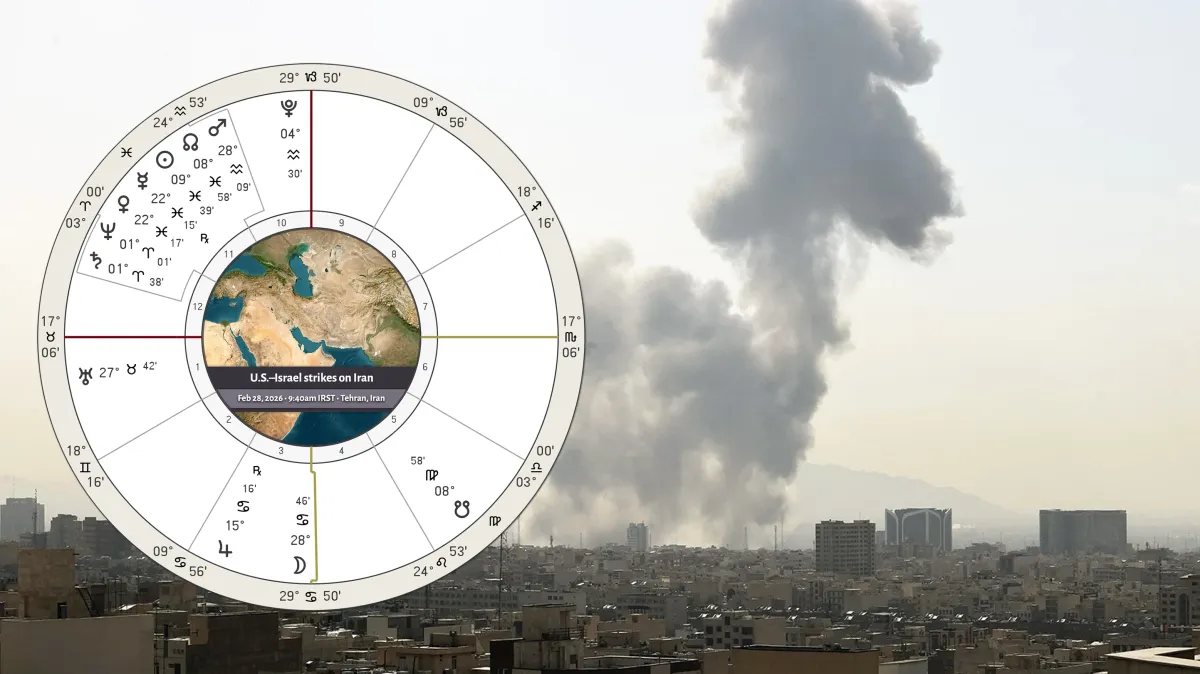
In the early hours of February 28, 2026, the United States and Israel launched a coordinated military campaign against the Islamic Republic of Iran, adding to the number of significant escalations in Middle East conflict. Codenamed by some sources as Operation Epic Fury, the offensive included massive airstrikes on Tehran and other cities, targeting Iran’s nuclear and missile infrastructure as well as senior leadership, including Supreme Leader Ayatollah Ali Khamenei. Iran confirmed Khamenei’s death following the strikes, a development with major implications for the country’s political future.
The assault triggered immediate and extensive retaliation. Iran’s Islamic Revolutionary Guard Corps launched ballistic missiles and drones at Israeli territory and U.S. military bases in Gulf states, drawing Bahrain, the United Arab Emirates, Qatar, Kuwait, and other nations into heightened states of alert. Airspace closures and disruptions to commercial travel quickly followed, and global oil markets reacted sharply to fears of prolonged instability.
Human cost has been severe. Iranian authorities and humanitarian agencies report hundreds of deaths within Iran, including a large number of civilians. One of the starkest instances was the destruction of a girls’ elementary school in Minab, Hormozgan province, where state media cited around 180 fatalities – primarily children – though figures remain contested and are being regularly updated. The attacks have hit over 130 Iranian cities with airstrikes and missile strikes since the campaign began, leaving over 550 people dead in Iran according to the Iranian Red Crescent Society.
Across the wider Middle East the conflict has quickly broadened beyond Iran’s borders. Iran’s retaliatory missile and drone barrages have struck Gulf states including the United Arab Emirates, where at least three foreign civilians were killed and dozens wounded in Abu Dhabi and Dubai after Iranian barrages and interceptor debris damaged residential and commercial areas.
In Israel, Iranian projectiles have killed at least 11 civilians, and Lebanese territory has been drawn directly into the fighting after Hezbollah launched rockets and drones into northern Israel, prompting Israeli airstrikes on Hezbollah positions in and around Beirut that have so far resulted in at least 31 deaths and many more wounded, with civilians among the casualties.
In Kuwait, Iranian attacks contributed to a “friendly fire” incident that brought down three U.S. jets, and Gulf airspace closures have left commercial hubs like Dubai and Doha in disarray.
World leaders have urged restraint, warning that the strikes and Iran’s retaliation risk widening into an even broader conflict – with European officials calling for ‘maximum restraint’ to prevent the crisis from threatening the Middle East and beyond, and commentators in the American press describing the operation’s unpredictable fallout as a profound risk to regional stability and security.
The chart for the initial strike
Reports generally agree that the first strike was heard at 9:40 am local time, with Le Monde and several other major outlets citing that specific time. That is the commencement moment I will use for this chart.
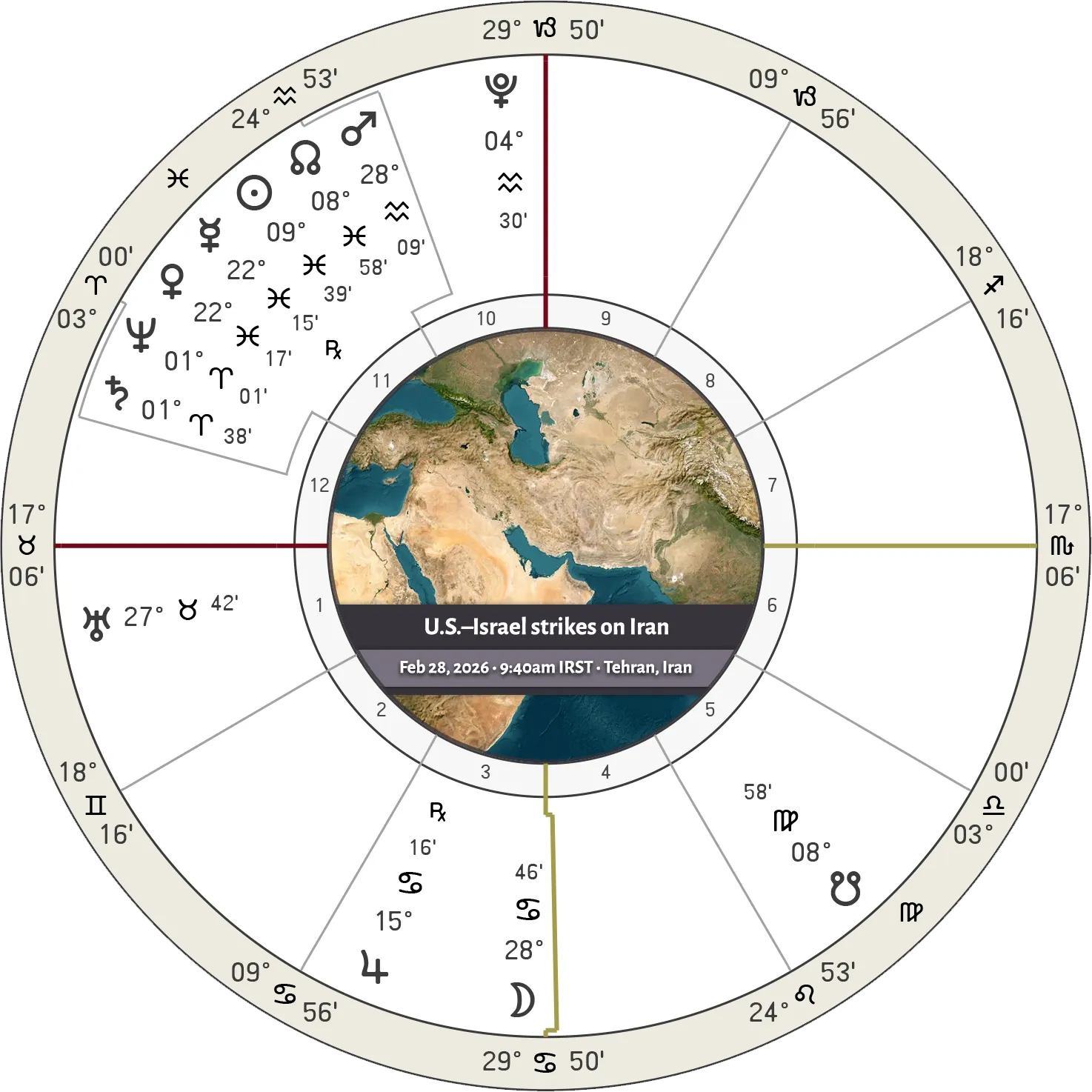
This is a dramatic chart. Pluto near the midheaven is violent, volcanic, destructive. Uranus rising is explosive and disruptive, the kind of signature that accompanies fire and rupture. Mars square Uranus compounds that volatility.
But none of this is unique to February 28. At present, Pluto and Uranus fall into this angular relationship once each day in nearly every city around the world, and have for more than a decade. And the Mars–Uranus square is a global condition, not unique to any one locality. It didn’t automatically translate into explosions in every capital.
So the question becomes sharper: why here, and why now? Why did this violence manifest between the United States and Iran on this date, rather than dispersing elsewhere, or waiting for another day?
The answer lies in the principle of radicality. A moment is radical – from radix, root – because it was seeded somewhere in the past, now coming to fruit. Astrologically we see radicality by the degrees and placements of major planets and angles, as they reach back into the foundational charts of the parties involved, drawing out older symbolism that is already embedded there. This first-strike chart does exactly that: it activates the root structures of both nations, and in doing so, makes the violence local rather than diffuse.
In my estimation, the key triggers were these:
- Mars at 28° Aquarius
- The Moon at 28° Cancer
- Saturn and Neptune newly conjoined at 1° Aries
- Honorable mention: Pluto at 4° Aquarius
These are tight, near-exact contacts to foundational charts for both nations and to the recent eclipse as it appeared over Washington and Tehran. That concentration narrows the field and marks this moment as primed for ignition between the U.S. and Iran.
Mars at 28° Aquarius
Cold strategy. Disciplined force. Coordinated networks. Ideological militancy. Organized dissent. Systems under strain. Tactical precision. Collective mobilization. Detached aggression. Engineering conflict. Structural disruption. Calculated escalation.
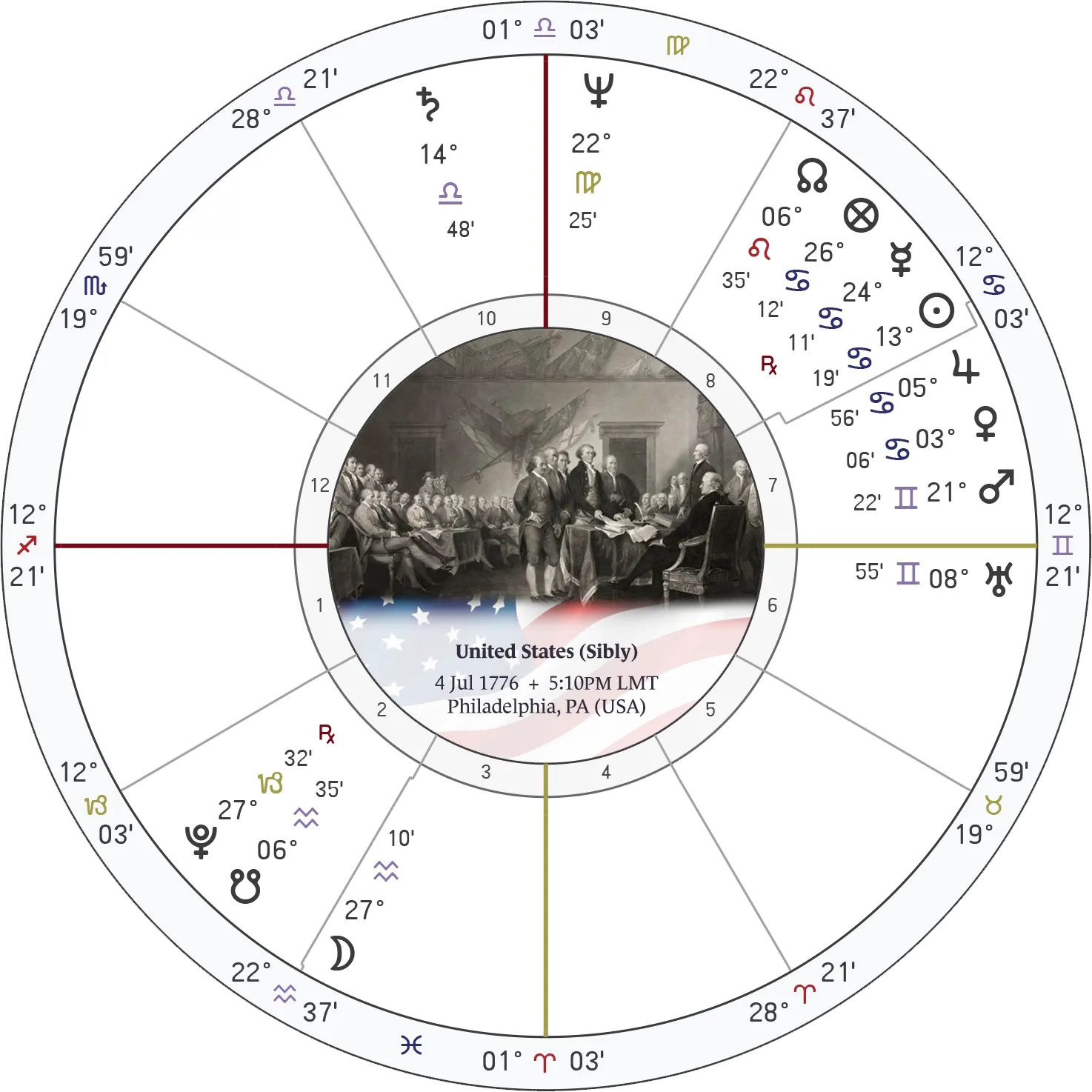
This Mars lands squarely on the Moon of the United States Sibly chart. When Mars transits a nation’s Moon, it tends to stir controversy in the public sphere, bringing the body of the nation toward conflict and violence. In the national chart, the Moon also sits on the 3rd house cusp, which points to communication networks and allied nations. It is almost inevitable that member nations in common accord with the United States will be drawn in, and that this issue will burn hot in printed media and public discourse.
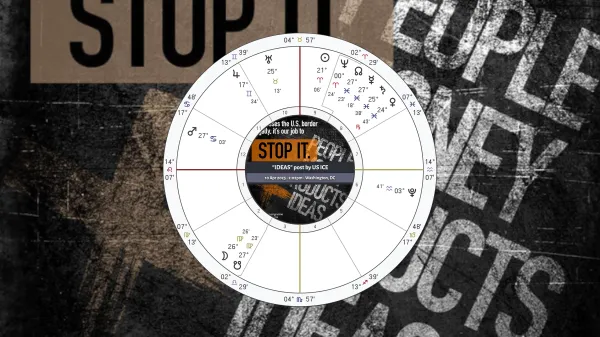
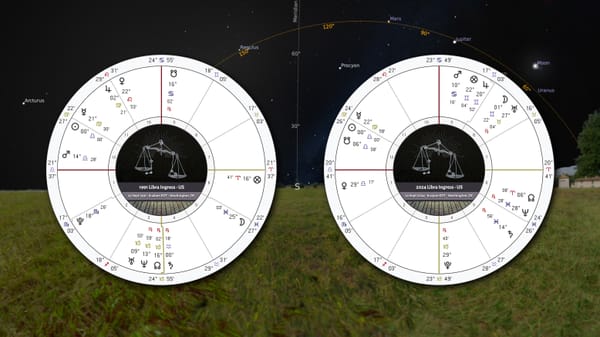
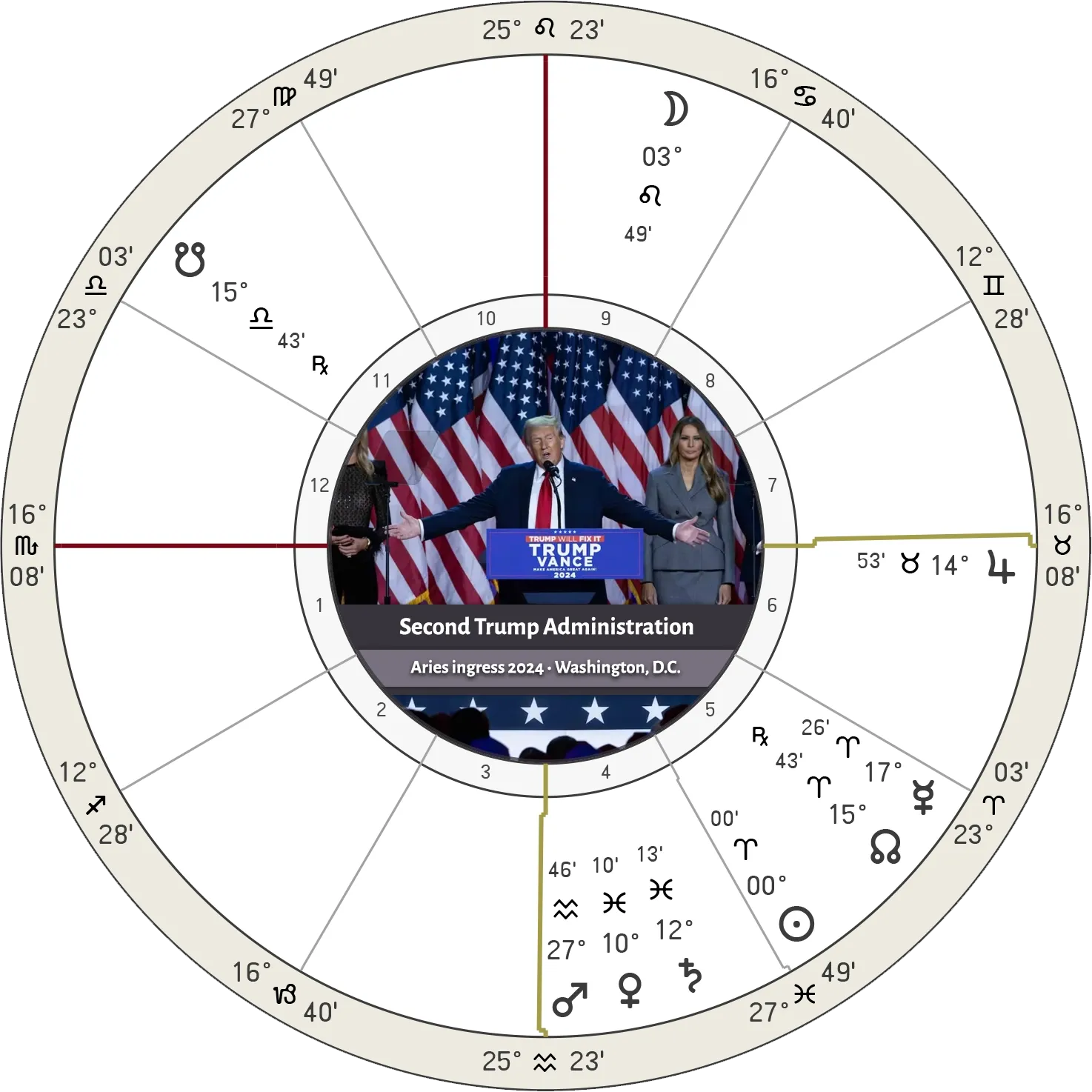
This Mars is also a Mars return to the chart of the second Trump administration, a cycle that by definition reactivates the executive’s assertion of will and use of force. In the 2024 Aries ingress chart, Mars stood at 27° Aquarius on the 4th house cusp, a placement suggestive of violent activity stirring domestic unrest. That theme has been consistent with this administration’s record – domestic deployments of ICE and the National Guard, and military action in peripheral theaters like what we saw in Venezuela.
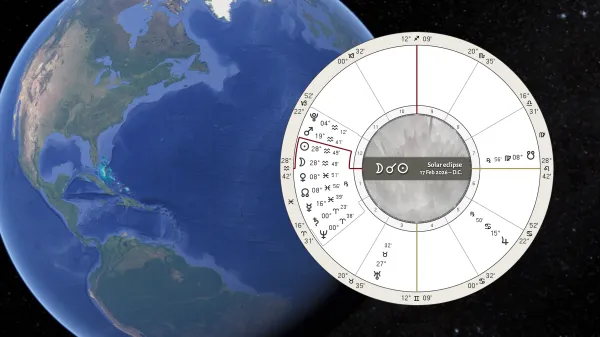
There was also a recent solar eclipse at 28° Aquarius. Over Washington, that eclipse was rising and on the U.S. Moon, and many astrologers remarked on its intensity as a trigger point in the national chart. When Mars crossed back over that eclipse degree in the strike chart, it was a reactivation of an already sensitive meridian. In Tehran, the same eclipse perfected on the 8th house cusp, with 1° Leo rising, within two degrees of the Trump administration Moon at 3° Leo, which weaves the eclipse into both sides of this encounter.
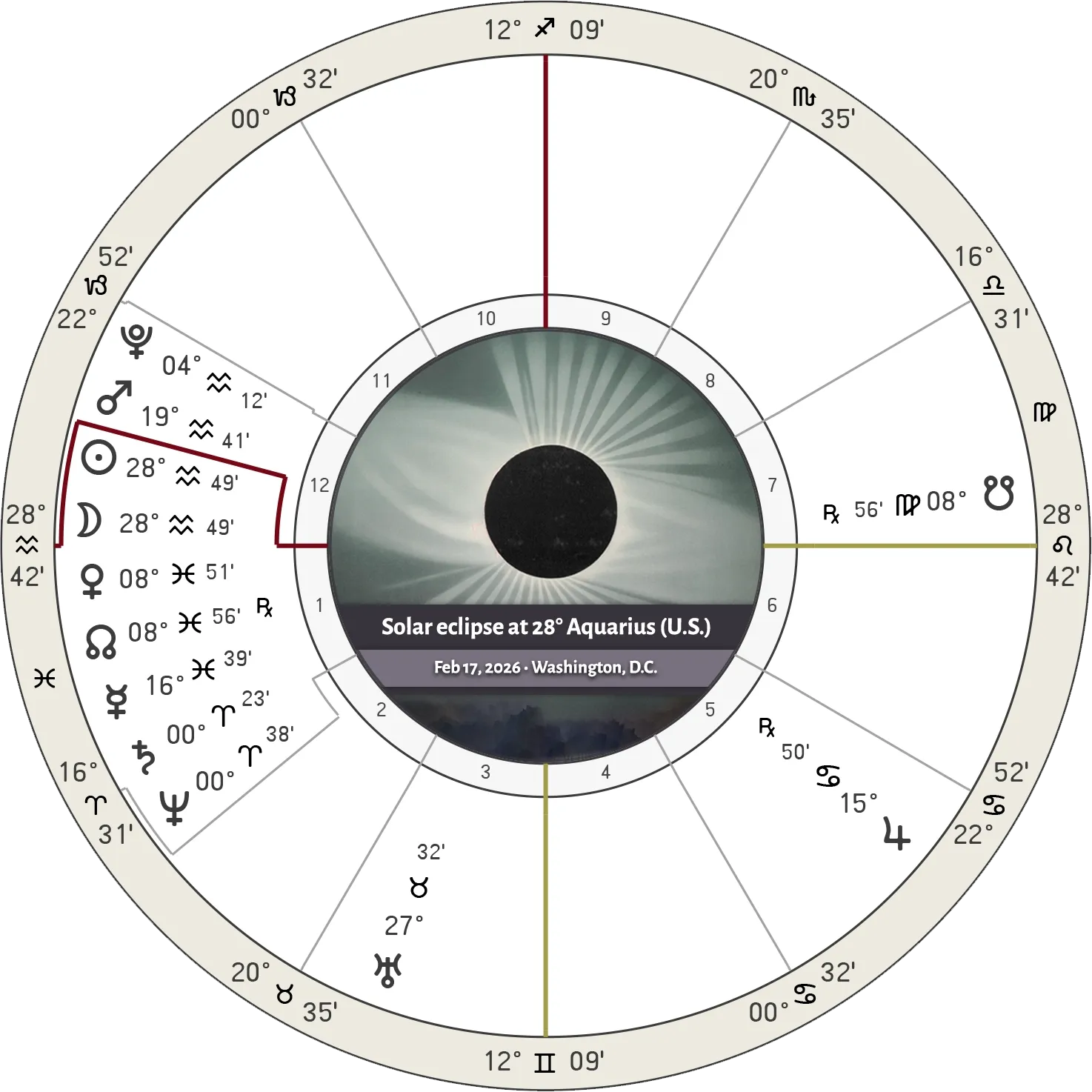
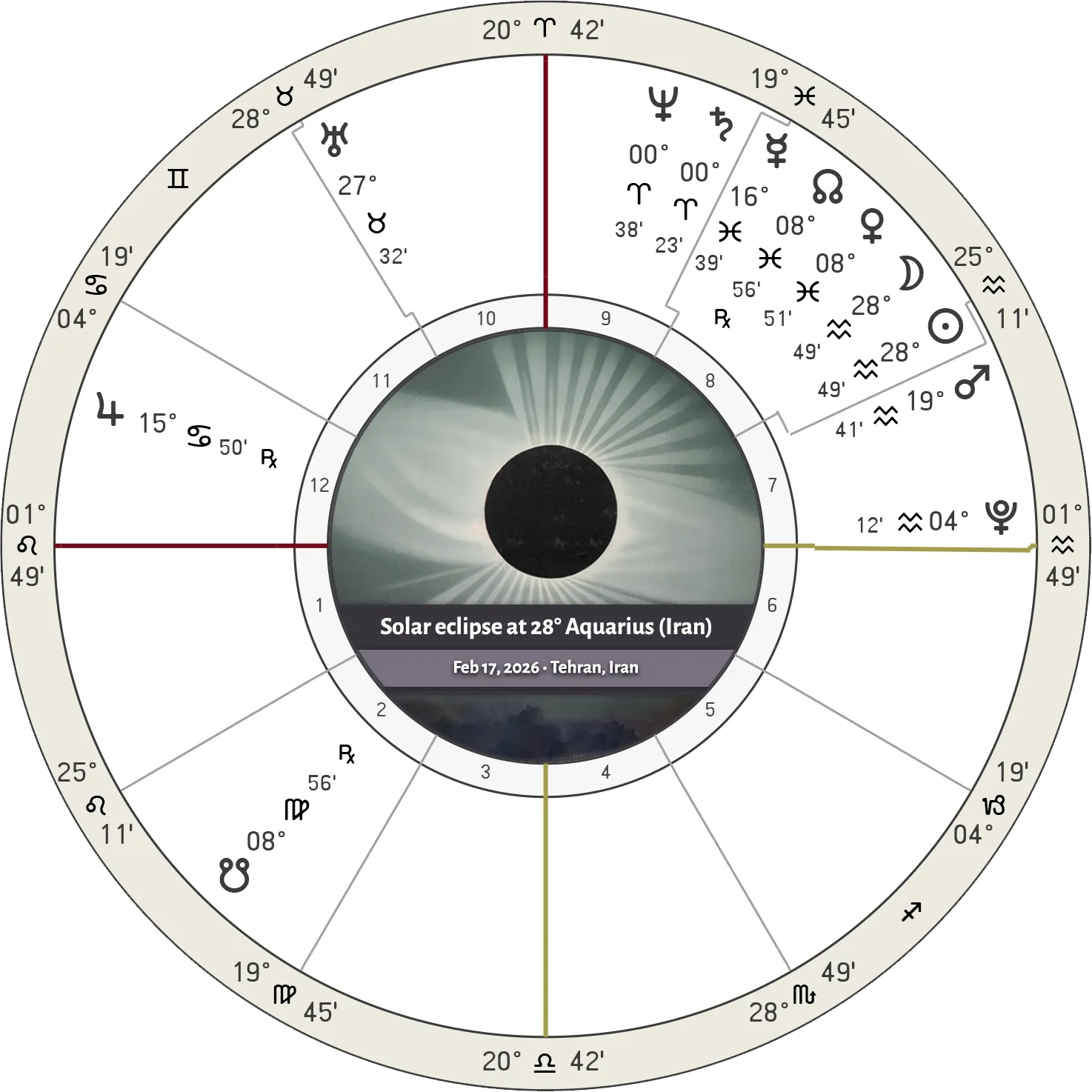
And then there is Mars square to Uranus – an aspect that increases anxious, erratic tension, the potential for abrupt rupture and escalatory escalation. Uranus at 27° Taurus was transiting, by degree, the ascendant of the Aries ingress chart for the year the Islamic Republic came into power (also at 27° Taurus). That degree contact lends a kind of unpredictable electricity to this moment, marking Mars’ action not just as forceful but as something pushed over a threshold that the Islamic Republic’s own foundational sky has been sensitized to receive.
The Moon at 28° Cancer
Maritime chokepoints. Ports and harbors. Oil tankers at risk. Shipping lanes under threat. Grain and fuel supply. Import dependence. Protective borders. Civilian shelter. National security posture. Trade entanglement. Collective fear. Public mourning. Strategic containment. Escalation through commerce.
The Moon at 28° Cancer is a major signature here, as it ties many things together at once. In the lunation preceding the 2024 general election, Mars stood in late Cancer on the 9th house cusp – a placement that intimated foreign conflict, ideological positioning, and the projection of force beyond national borders.
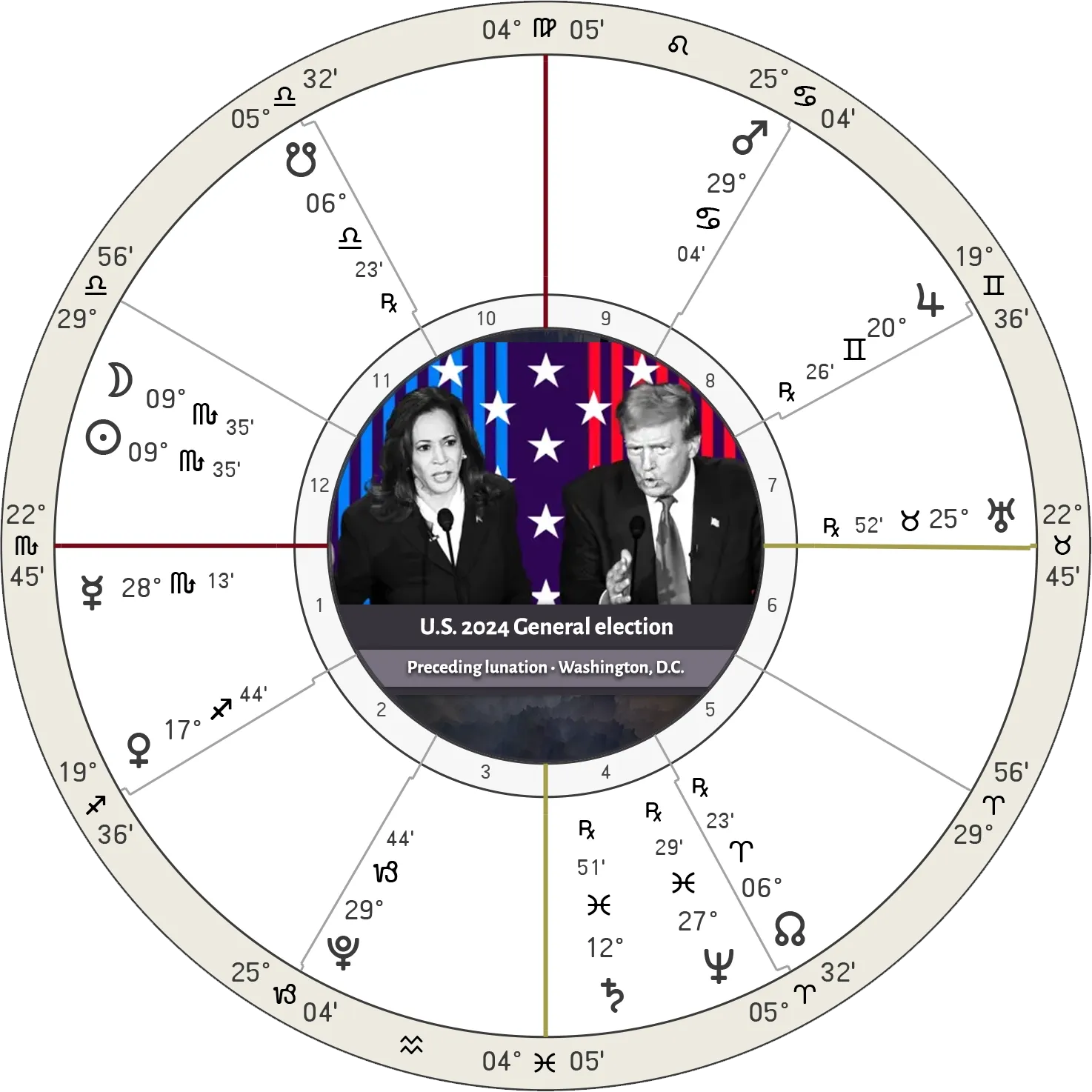
It also reactivates the late-Cancer concentration in the lunation preceding Trump’s inauguration, where the ascendant, Moon, and Mars cluster in that sign. That configuration fused executive authority, public mood, and martial assertion at the outset of the administration. When any planet returns by transit to the final degrees of Cancer, it stirs that cantankerous conjunction into manifestation.
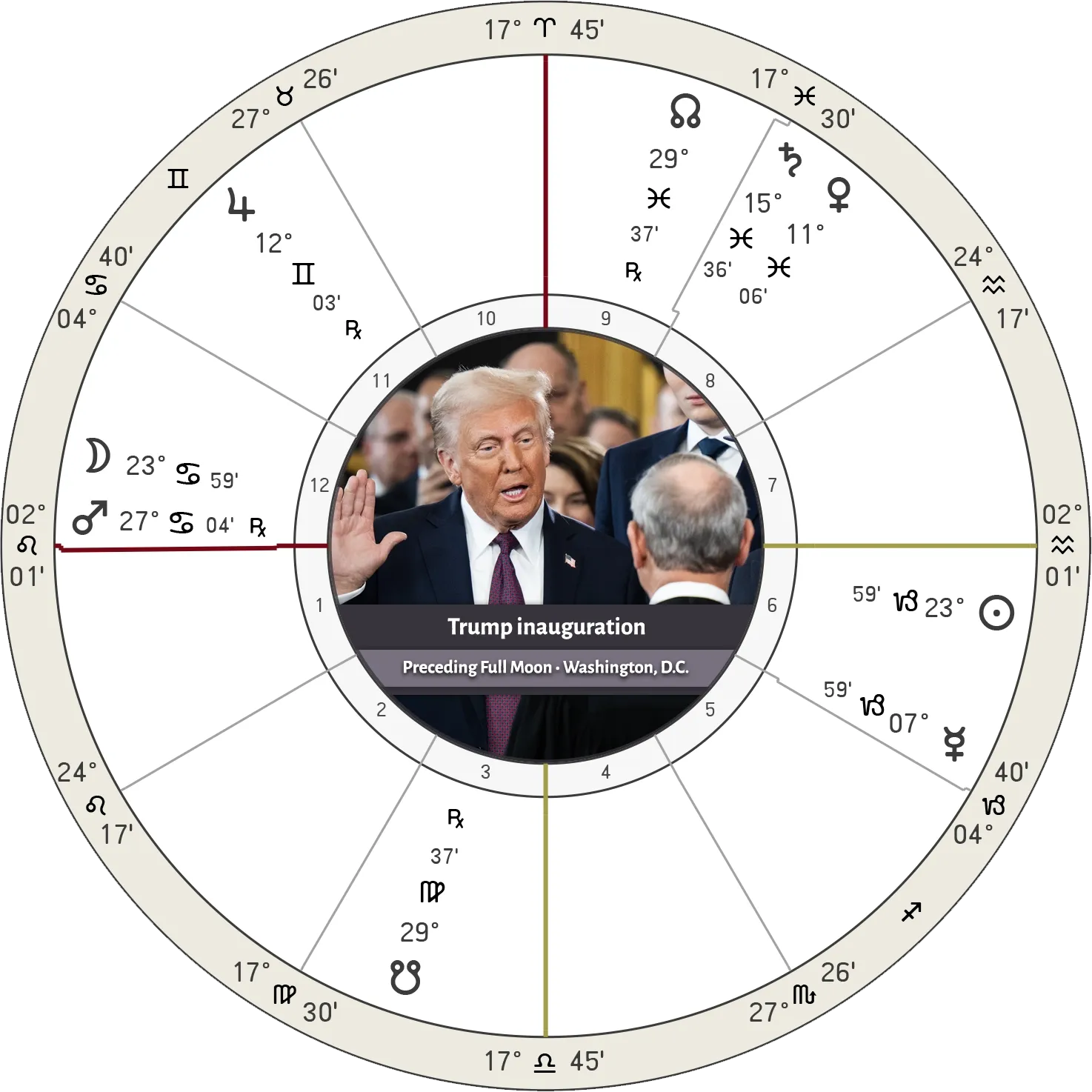
On a personal level, the transit touches Trump’s natal Saturn–Venus conjunction around 25° Cancer. For Iran, the degree is equally sensitive. The Islamic Republic’s natal Jupiter sits at 29° Cancer, where we also find Khamenei’s natal Pluto. Pezeshkian’s natal Jupiter–Uranus conjunction falls nearby at 27° Cancer. The strike chart’s Moon at 28° Cancer activates all of it.
See charts for Iran in Mundane Matters: Charts of political importance.
Saturn and Neptune conjunction at 1° Aries
Dissolving boundaries. Militarized ideology. Structured illusion. Sacrifice framed as necessity. Erosion of restraint. Holy war rhetoric. Institutional fatigue. Command under fog. Manufactured consent. Martyrdom narratives. Containment failing. Force without clarity. Hard lines drawn in sand. Faith weaponized. Authority tested at ignition point.
The Saturn–Neptune conjunction in early Aries carries particular weight for the United States because it falls in exact opposition to the Sibly chart midheaven of 1° Libra. That degree shows executive authority, national leadership, and the visible projection of power. When Saturn and Neptune oppose that point, questions of legitimacy, structure, dissolution, and ideological strain move directly onto the public stage. Astrologer Mari Garcia notes that this conjunction on the nation's 4th house cusp describes "the de-stabilisation of the fundamentals upon which U.S. governance is based" – in this particular context, Congressional oversight and approval on war acts.
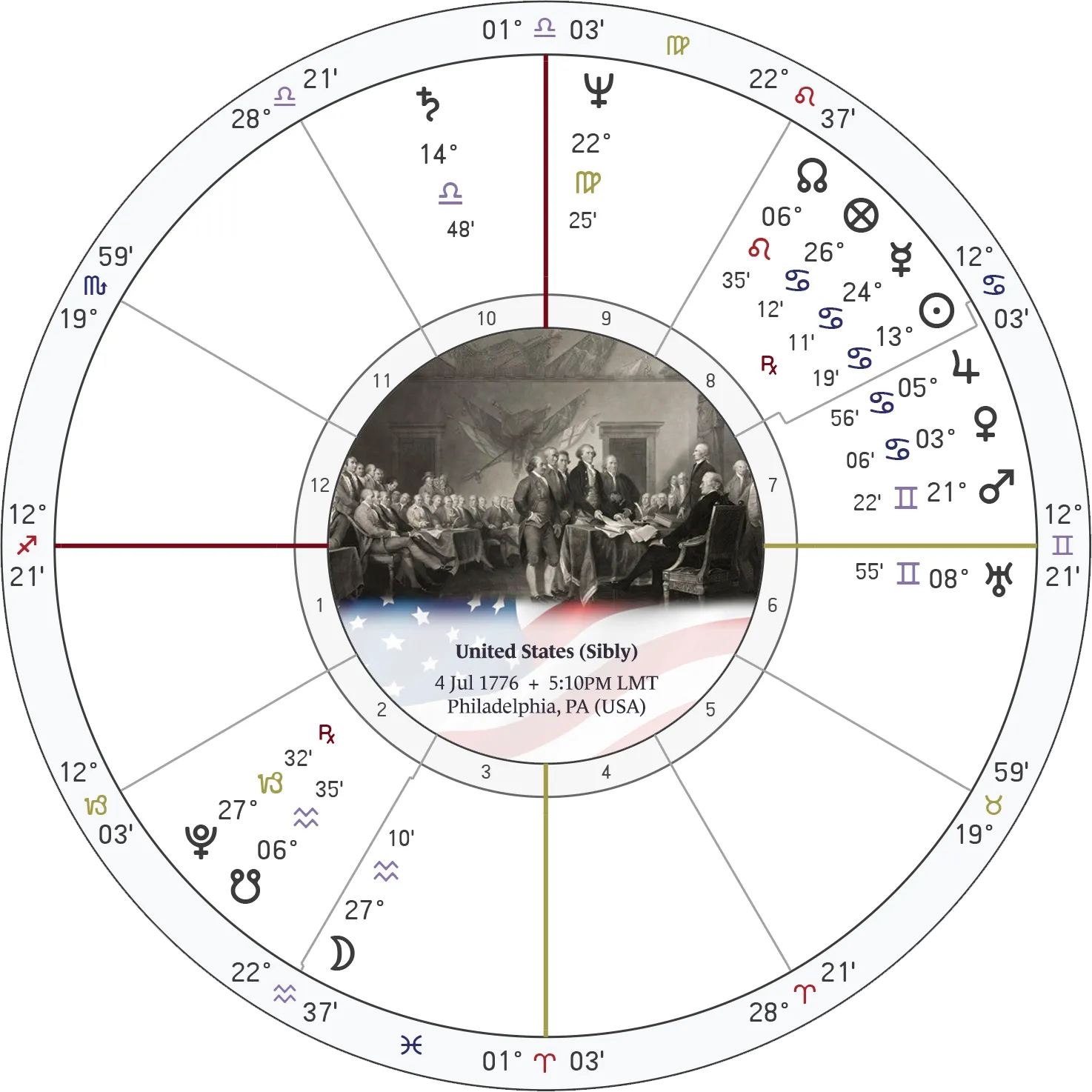
Saturn in Aries has long been associated with stress to rulers. Aries is the sign of the Sun’s exaltation, and when Saturn occupies that terrain it often appears in close proximity to the Sun in adjacent Aries ingress charts. The symbolism is stark: constraint imposed upon leadership, corrosion of authority, the burdening or fall of prominent figures. With Neptune joined to Saturn, the theme is amplified: boundaries blur, clarity erodes, institutional strength and mythic projection collapse into one another.
There is also a precise Iranian dimension to this conjunction. The Islamic Republic was formally established on April 1, 1979. The lunation preceding that date occurred at 6° Aries, a New Moon uniting Sun and Moon a mere 5° away from the Saturn–Neptune conjunction. Their position is a hard, exacting transit to a foundational chart for the Republic itself, and presses upon the seed moment from which the regime took form.
Honorable mention: Pluto at 4° Aquarius
Pluto in Aquarius may be slow, but at 4° Aquarius, it forms a very tight opposition to two key points. First, it opposes the Trump administration’s Moon at 3° Leo, a placement that ties public mood, national identity, and the executive’s emotional register to this long-term transformational pressure. Second, the same Pluto opposes the ascendant of the recent solar eclipse as seen from Tehran, another structurally significant angle that was highlighted in many astrologers’ readings of that eclipse as a trigger moment for Iranian national identity and crisis potential. The opposition doesn’t generate the event by itself, but it pressurizes long-term, subterranean forces – power, decline, exposure, collective death and rebirth – against the living charts of both sides. In the context of a chart already laden with near-exact transits to foundational degrees, Pluto’s opposition acts like a slow, unrelenting squeeze, bringing the subterranean debts of history up into the immediate moment.
Looking ahead
There are signals of both relief and renewed tension in the coming months.
By mid-June, Jupiter will pass over the late degrees of Cancer, with a simultaneous transit from Venus in early Leo. When benefics move through degrees that have recently been inflamed, they often bring some measure of restoration, diplomatic overture, or temporary easing. Jupiter in late Cancer could correspond with negotiations tied to maritime trade, sanctions, or supply chains – the very Cancerian themes that have been under pressure. Venus crossing early Leo may soften rhetoric, particularly where executive pride and national image are concerned, and also indicate something about the position of women in the new Iran.
But those same weeks are not without serious friction. Mars will be in mid-Taurus, squaring its position at the time of the strikes and moving toward conjunction with the Uranus activated in this chart. That is not a pacifying signature. Mars–Uranus contacts tend to elevate military figures, embolden hardline actors, and reward those willing to act decisively and abruptly. Even where diplomacy appears to surface, force remains close to the edge.
As the United States approaches its 250th birthday on July 4, Mercury will station retrograde at 26° Cancer. Negotiations begun under that sky are unlikely to resolve cleanly on first pass. Messages may be retracted, reinterpreted, or walked back. Around the same time, Mars and Uranus will conjoin in early Gemini, while Saturn forms an exact opposition to the United States’ natal Saturn – a classic signature of reckoning, backlash, and institutional strain. Pressure may build not only on the President, but on the nation’s structures more broadly.
It is possible that some of these configurations will manifest elsewhere. Only weeks ago, global attention was fixed on Venezuela. What we can say with confidence is that the sky through June and early July remains volatile, and that this tension is likely to resurface in November, when Jupiter, Mars, and the South Node conjoin at 25° Leo in direct opposition to the strike Mars. There are openings for stabilization, but they sit alongside signatures that can quickly reignite conflict.
In moments like this, caution is warranted. The degrees that ignited this confrontation have not yet fully dispersed. Watching them day by day may be wiser than projecting too far ahead under a presidency defined by rapid shifts in posture and tone.
A prayer for peace
None of this has happened in a moral vacuum. The violence of February 28 was devastating in its human cost – from the children killed in school strikes to the civilians caught in crossfire across multiple countries. Ayatollah Khamenei’s record of repression was real and abhorrent, just as leaders like Nicolás Maduro have posed serious problems for their own populations.
But the fact that powerful states and armed groups like the United States, Israel, Iran, and Hezbollah can light each other up in pursuit of dominance does not absolve them of responsibility for the lives torn apart in the process.
The degrees in the sky may describe the astrological pressures at work, but on the ground it is ordinary people who bear the consequences. As we move into the coming months, with both moments of possible easing and signatures of renewed tension ahead, it will matter how we pay attention – not just to geopolitics, but to one another’s suffering, and the joy waiting to take root.
There is space in the heavens for relief and resolution, but there is also work to be done here on earth if we are to make the most of it.
Make us as waves of the sea, flowers of the garden, united, agreed through the bounties of Thy love. O Lord! Dilate the breasts through the signs of Thy oneness, and make all mankind as stars shining from the same height of glory, as perfect fruits growing upon Thy tree of life.
– A prayer for unity from Persian spiritual leader ‘Abdu’l-Bahá (b. Tehran 1844, d. Haifa 1921)