Free and fair elections in 2026

Abstract
Recent remarks questioning the necessity of elections, alongside an expanding pattern of domestic force deployments and legal conflict, have raised renewed concern about the stability of U.S. elections ahead of the 2026 midterms.
This article examines how extraordinary executive authorities – particularly the Insurrection Act of 1807 – have historically moved from dormant statute into active consideration during periods of internal stress, and what conditions tend to accompany that shift.
Drawing on legal history, documented instances of invocation, and recurring astrological patterns associated with both the Act’s creation and its use, the analysis identifies a convergence of factors surrounding the 2026 midterm elections that suggests heightened institutional and civic vulnerability.
Rather than forecasting outcomes, the article situates the coming period as one in which pressure points are becoming visible, choices carry long shadows, and the consequences of miscalculation may extend well beyond election day and into the 2027 astrological year.
Free and fair elections in 2026
Over the past several weeks, a question that once belonged to the margins of political analysis has moved closer to the center of public discussion: whether the conditions for a free and fair U.S. election could be deliberately impaired by executive action.
This concern follows a series of remarks, reported by Reuters [1], in which President Donald Trump openly questioned the necessity of elections in the context of the 2026 midterms. While allies have framed those comments as rhetorical or offhand, they have nonetheless sharpened attention on a more serious issue – whether elections could be cancelled outright, or rendered dysfunctional, unsafe, or effectively inaccessible in practice.
Democratic breakdown rarely announces itself through the abolition of elections outright. Far more often, it proceeds through the erosion of the conditions that make elections meaningful: secure access to polling places, easy and accessible voter registration, administrative continuity, public confidence in process, and the absence of intimidation. In this sense, the relevant question might not be whether ballots would exist, but whether voters could reasonably cast them, have them counted, and trust the outcome. That frame has become increasingly salient as domestic uses of federal force have shifted from hypothetical to routine elements of governance.
Over the last year, the Trump administration has seen repeated deployments and threatened deployments of federalized force in civilian settings, particularly in large, Democratic-led cities that did not support Trump in the 2024 election. These actions have unfolded through a mix of National Guard mobilizations, federal law enforcement surges, and preparations for possible active-duty involvement. Legal challenges have followed, but so has a noticeable pattern of violent escalation, judicial scrutiny, political backlash, and repetition in a new location under slightly altered justifications.
Such extraordinary circumstances have begun to settle into a background rhythm of federal–local conflict.

From this pattern, an authoritarian government can learn two things. First, it can function as a stress test of the military’s domestic preparedness – probing how quickly troops can be mobilized, what rules of engagement will be tolerated, and how far civilian law enforcement boundaries can be pushed before courts intervene.
Second, it can serve as a mechanism of desensitization. Each deployment lowers the psychological threshold for the next, making the presence of armed federal personnel in civilian spaces feel increasingly like routine operation. Experts have noted that the gap between crowd control, infrastructure protection, and electoral interference narrows in conditions like these.
Recent reporting underscores how close these dynamics already sit to electoral timelines. In January 2026, Pentagon officials confirmed that approximately 1,500 active-duty soldiers had been placed on prepare-to-deploy status in connection with potential domestic unrest tied to federal enforcement actions. [2] Escalation from civil dispute to military readiness is no longer hypothetical. In Minneapolis, a federal immigration operation rapidly escalated into mass protest, forceful crowd-control measures, and open discussion of military deployment, all within a matter of days.
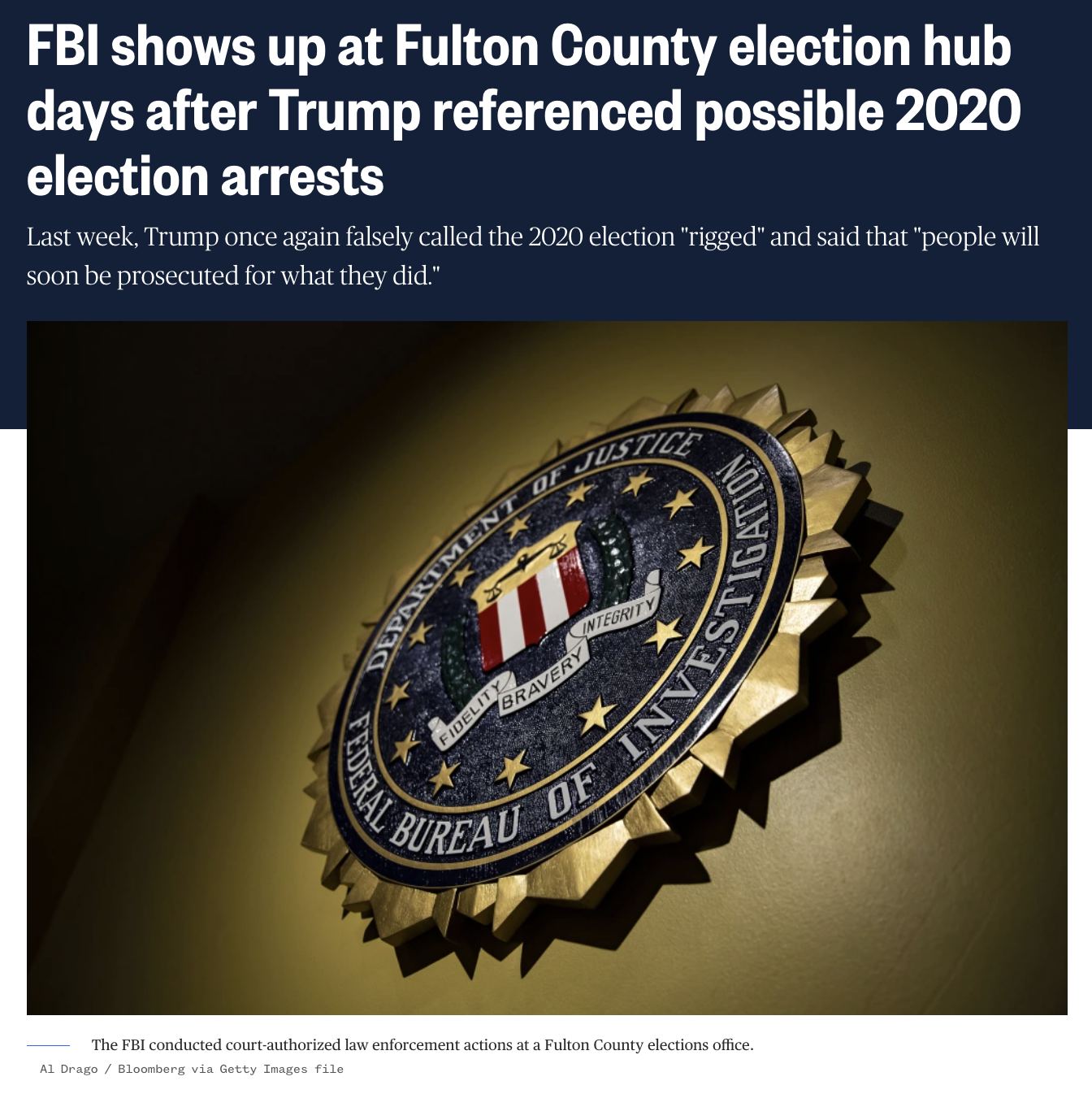
More recently, federal law enforcement activity has moved closer to election infrastructure itself: just days after Trump again referenced the possibility of interference in the 2026 vote, the FBI presented a warrant to the Fulton County elections board, an action that has drawn national attention regardless of how the investigation ultimately resolves.
Against this backdrop, we can see that the path to electoral disruption doesn't require a dramatic seizure of ballot boxes. It could emerge through more diffuse means: protests or enforcement actions near polling sites; strained or suspended local election administration; intimidation of poll workers; or the framing of certain jurisdictions as too unstable to conduct voting “safely.” Even short-lived disruptions can have outsized effects in midterm elections, where turnout margins are thin and administrative delays can cascade into legal and political crises.
As these risks have become more visible, democracy watchdogs and security analysts have increasingly focused on the legal authorities that could plausibly be used in such circumstances. Among them, the Insurrection Act of 1807 is frequently cited, given its historical role as a domestic force authorization. That statute, its ambiguities, and its susceptibility to executive overreach form the hinge between abstract concern and concrete mechanism.
The Insurrection Act of 1807
The Insurrection Act was enacted in 1807 in response to a problem that preoccupied the early United States: how a weak federal government could preserve internal order without standing armies permanently embedded in civilian life. The republic that emerged from the Revolutionary War was deeply suspicious of centralized military power, yet acutely aware that rebellion, foreign interference, and interstate disorder posed existential threats. [3] The Act was designed as a contingency mechanism – a last-resort authority that would allow the federal government to deploy military force domestically when ordinary civil processes were no longer capable of functioning.
Its intellectual and political roots stretch back to the first decade of the republic, particularly to moments such as Shays’ Rebellion in the 1780s, when state governments proved unable to suppress armed uprisings without federal assistance. [4] The Constitution had already granted Congress the power to call forth the militia to “execute the Laws of the Union, suppress Insurrections and repel Invasions” (Article I, Section 8, Clause 15), but early lawmakers recognized that this authority needed statutory scaffolding. The Insurrection Act was intended to supply that structure – specifying when and how the president could act if states were unwilling or unable to enforce federal law.
The statute reflected the governing assumptions of its era, namely that insurrection would be visible, organized, and overt – i.e., armed rebellion rather than diffuse civil unrest. It also assumed a president acting as a neutral guarantor of constitutional order rather than as a partisan actor with a personal or political stake in the outcome of domestic conflict. The Act therefore vested extraordinary discretion in the executive, on the theory that emergencies couldn't be managed through slow or fragmented decision-making. That discretion was tempered, in theory, by the rarity of its use and by the expectation that invoking it would carry immense political cost.
What the Insurrection Act created, in a manner of speaking, was a constitutional escape hatch: a mechanism that could override normal civil constraints in moments of perceived breakdown. For much of American history, that hatch remained closed, opened only intermittently and under conditions widely recognized as exceptional. Whether those conditions still apply, and how elastic the definition of “insurrection” has become, is a separate question – one that cannot be answered without examining how the Act has actually been used, interpreted, and contested over time.
Astrology of the Insurrection Act
The Insurrection Act was a direct statutory extension of the earlier Militia Acts of 1792, which established the basic framework through which the federal government could call state militias into national service. Those earlier acts reflected the young republic’s anxiety about internal disorder and its simultaneous distrust of standing armies. They authorized the president to mobilize militia forces in cases where state governments couldn't or would not suppress insurrection or enforce federal law.

The 1807 Act expanded that authority by clarifying that federal troops themselves, not only state militias, could be deployed domestically under such conditions. In effect, the Insurrection Act transformed an improvised emergency power into a more durable executive tool, shifting the balance from cooperative federalism toward unilateral presidential discretion in moments of perceived breakdown. We’ll need to consider this throughline to establish an astrological pulse on the Act as we understand it today.
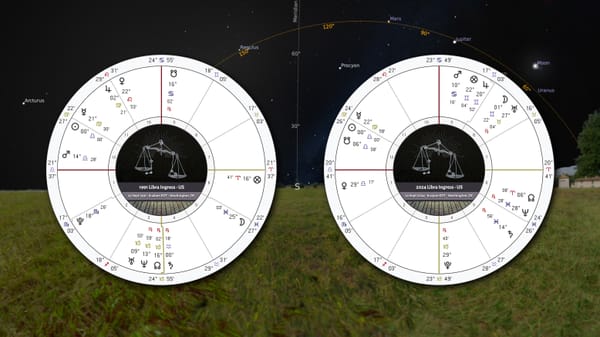
From an astrological perspective, there are several distinct points at which one might examine the signatures surrounding legislation of this kind. One obvious place to begin is with the Aries ingress chart of the president under whom the Act (and its predecessors) became law. These ingress charts, when cast for the seat of government, frequently offer reliable thematic outlines for an administration, including the kinds of pressures, conflicts, and decision points that are likely to recur during its tenure. They also help identify sensitive degrees and configurations that may later be activated when the underlying themes of a presidency are brought into sharper relief.
Equally important is the lunation immediately preceding the passage of such legislation. New and full Moons often provide a more concentrated view of the conditions likely to manifest within the two-week window that follows them, particularly when those conditions involve decisive action, coercion, or crisis management.
Because the Insurrection Act concerns the use of force within the domestic sphere, it's also reasonable to examine the most recent ingress of Mars prior to enactment – that is, the chart for Mars’ entry into the sign it occupied when the law was passed. Similar logic applies to the most recent ingresses of Jupiter and Mercury, both of which are relevant to questions of law, statute, interpretation, and political advocacy. Given the coercive and disciplinary nature of the Act, Saturn’s most recent ingress may also be considered, insofar as Saturn describes constraint, enforcement, and the imposition of order where consent and order has failed.
Rather than asking the reader to sift through dozens of individual charts, it's more expedient to summarize what emerges when these different lenses are applied collectively. Across the charts associated with the Militia Acts of 1792 and the Insurrection Act of 1807, three recurring signatures stand out with notable consistency.
The most prevalent of these, by a considerable margin, is the occupation of the middle to late degrees of Leo by a superior planet – Mars, Jupiter, or Saturn – or activity in the opposing degrees of Aquarius. This configuration appears repeatedly in the charts associated with both the earlier militia legislation and the later Insurrection Act itself. Its prominence suggests a recurring symbolic emphasis on authority, command, centralized power, and the assertion of control over collective bodies.
Two additional signatures appear less consistently, but often enough to merit attention. The first is planetary activity in the late degrees of Cancer, clustered around approximately 27° Cancer, or in the opposing Capricorn degrees. The second is activity in the very early degrees of Taurus, centered near 2° Taurus. These configurations do not appear in every relevant chart, but they recur frequently enough to function as secondary indicators alongside the dominant Leo–Aquarius axis.
In summary, the recurring signatures involve Saturn, Jupiter, or Mars; the lunar nodes; lunations; or the cusp of an upper angle (1st, 10th, and 7th houses), in the following places:
- Mid- to late Leo/Aquarius (major signature)
- Late Cancer (minor signature)
- Early Taurus/Scorpio (minor signature)
To see how these signatures manifest beyond theory, it is helpful to examine the astrology present at moments when the Act moved from statute into use.
The Brennan Center for Justice has assembled a historical record of instances in which the Insurrection Act, or its statutory predecessors, were invoked either formally or in ways that closely approximated formal invocation. [5]
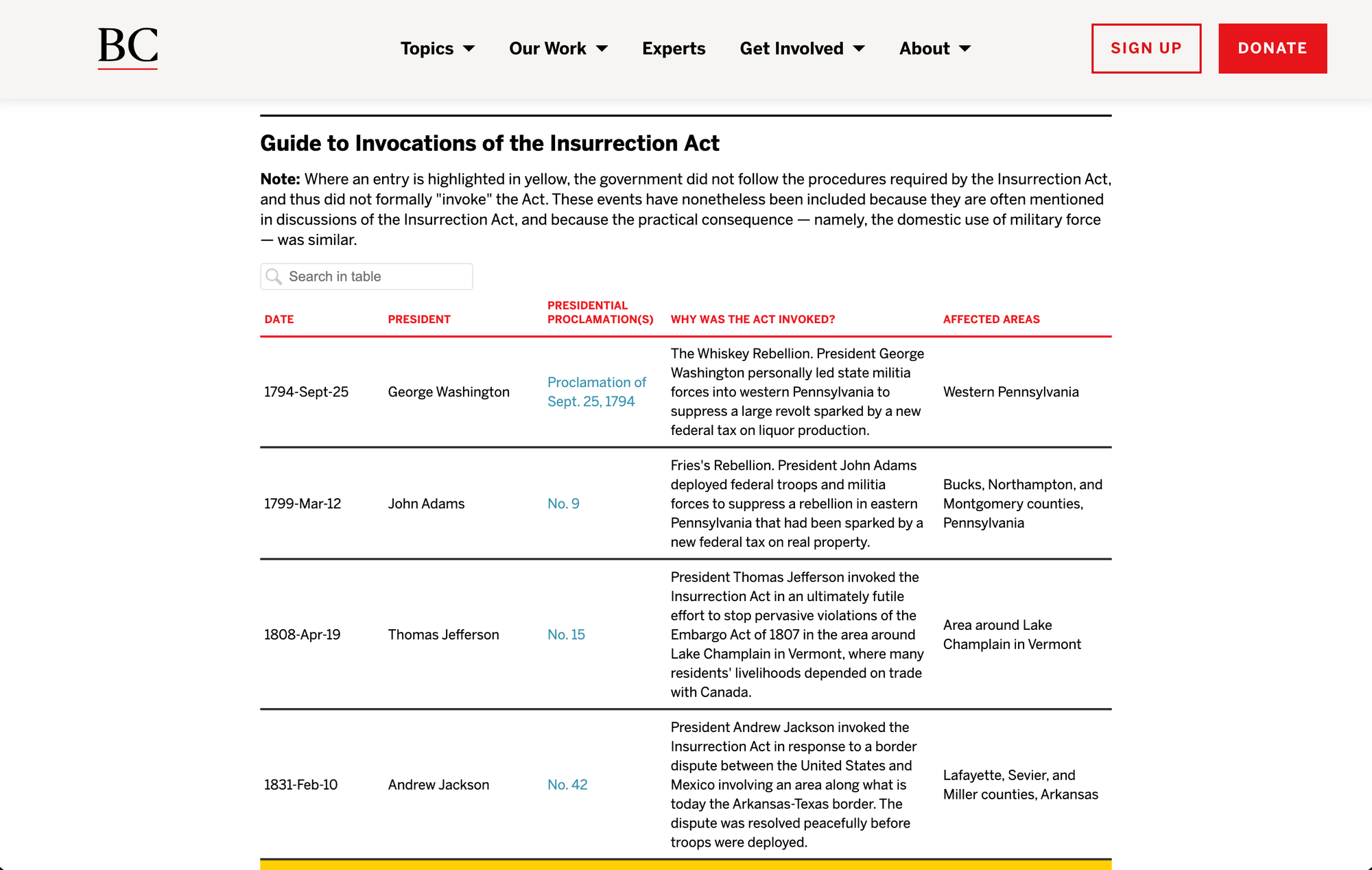
Approximately 80% of the listed events coincide with a lunation preceding the invocation that activates the primary signature (a superior planet transiting the middle to late degrees of Leo or the opposing Aquarius degrees). In roughly 65% of cases, one or both secondary signatures in late Cancer or early Taurus are also present. In no recorded instance does invocation occur without at least one of these signatures appearing in the preceding lunation.
This isn't, and should not be read as, a deterministic test. The historical record itself is uneven. In some cases, the Act was invoked but troops were never deployed, or were deployed too late to have meaningful effect. In others, the Act wasn't formally invoked at all, functioning instead as an implicit or explicit threat. Moreover, the moral and political contexts varied widely. Rutherford B. Hayes invoked federal force to suppress labor action during the Great Railroad Strike of 1877, acting in defense of industrial and commercial interests. Abraham Lincoln and later Ulysses S. Grant invoked the Act in response to racialized violence and armed rebellion tied to the defense of slavery and white supremacy. Each president acted under different pressures and for different ends, and it would be unreasonable to expect identical astrological expressions across such divergent circumstances.
Still, the persistence of these major and minor signatures suggests something more than coincidence. They do not explain motive, nor do they guarantee outcome. What they offer instead is a bounded, historically informed starting place for astrologers attempting to understand how and when this particular statute moves from dormant authority into active consideration.
With this baseline in mind, let’s consider the astrology of the 2026 midterm elections.
The 2026 midterms: a convergence worth taking seriously
The 2026 U.S. midterm elections are scheduled for Tuesday, 3 November 2026. In assessing elections astrologically, my standard practice is to begin with the lunation immediately preceding the vote, as this often provides a compressed view of the pressures and tendencies likely to shape the outcome and its surrounding conditions.
In this case, the preceding lunation is a full Moon at 2° Taurus on 26 October 2026. That placement is notable on its own, as it directly activates one of the secondary signatures observed in prior invocations of the Insurrection Act: early Taurus.
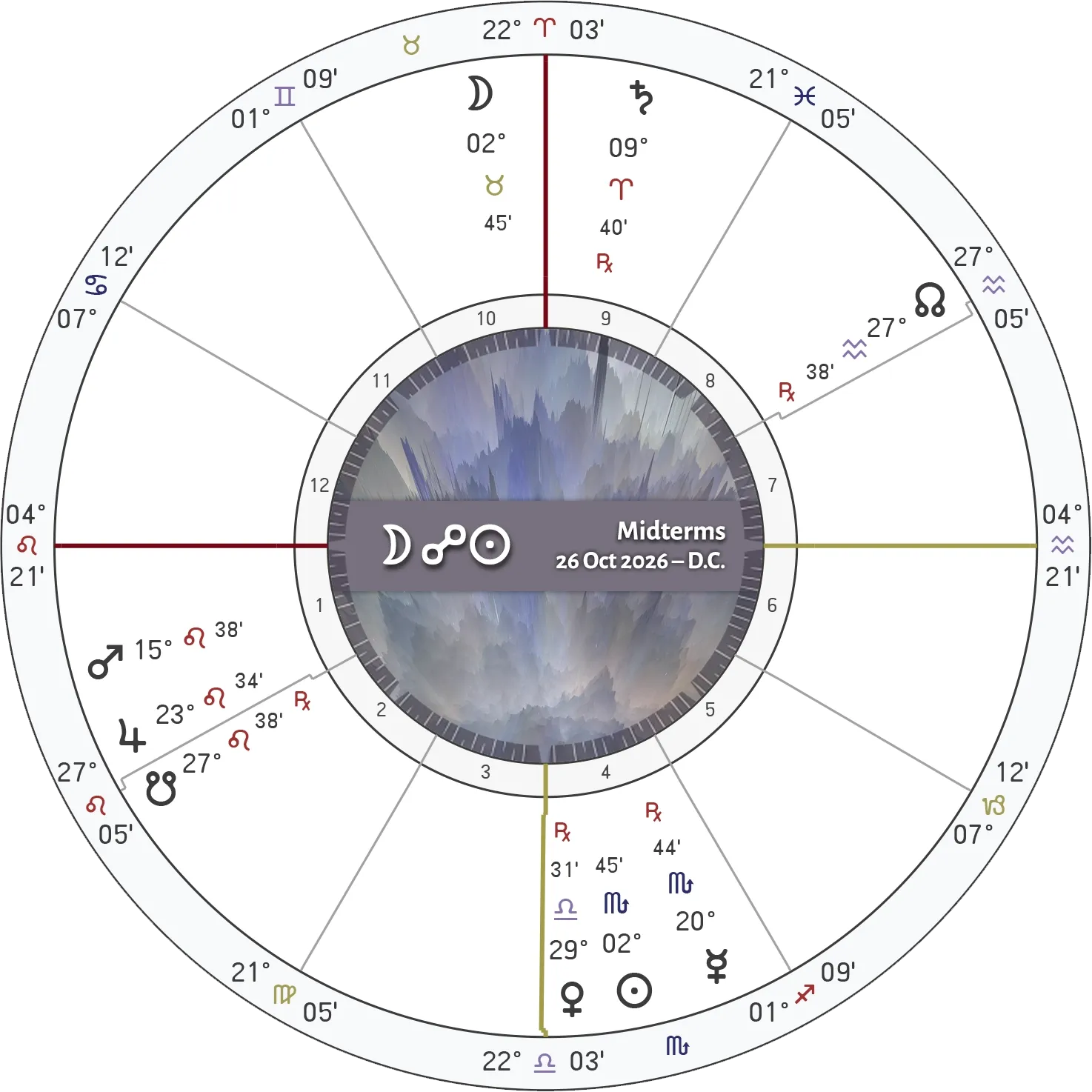
At the time of that lunation, a stellium of Mars, Jupiter, and the South Node builds toward conjunction at 25° Leo, with all three bodies ultimately occupying that degree. This configuration directly triggers the dominant signature identified earlier: superior planets in the middle to late degrees of Leo. That alone would warrant attention. What elevates the concern is the way this conjunction ties into the astrology of the current administration.
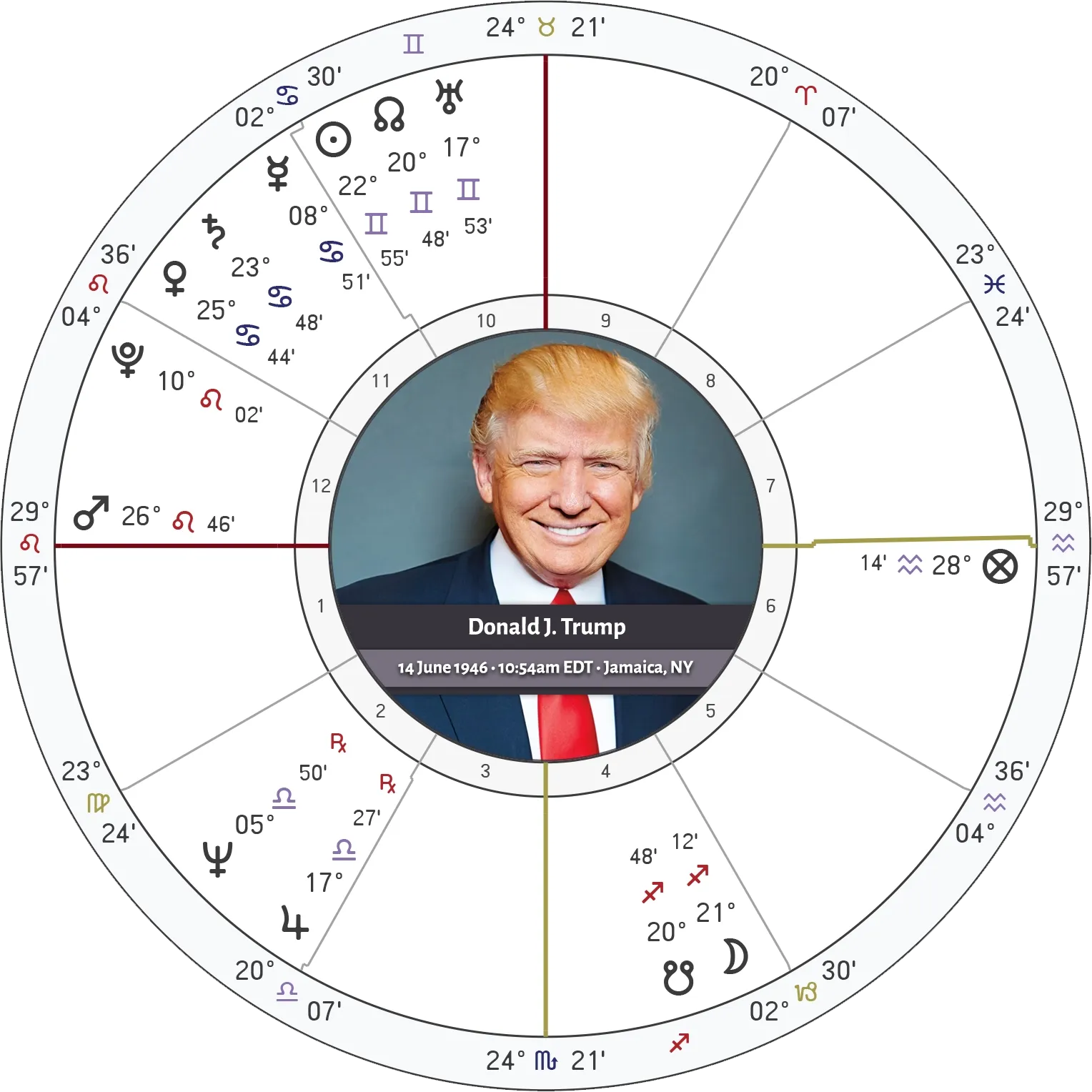
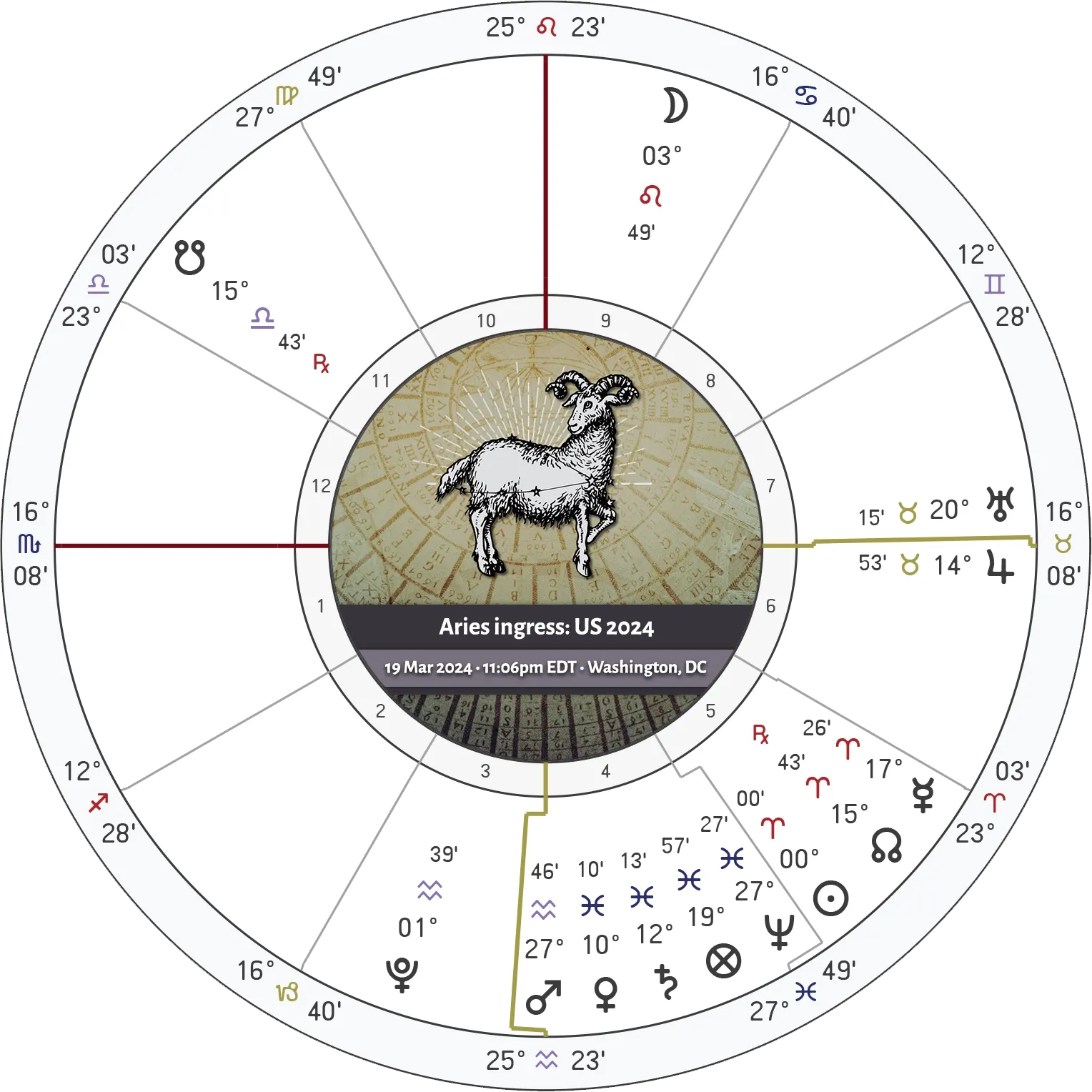
Left: Trump's natal chart. Right: Trump's second administration chart.
25° Leo closely aligns with Donald Trump’s natal Mars at 26° Leo and his ascendant at 29° Leo, and it also coincides with the midheaven of his administration’s chart (i.e., the 2024 Aries ingress), which had 25° Leo on the midheaven. Symbolically, this brings themes of force, authority, and executive action into direct contact with both the personal and institutional axes of the presidency. A Mars–Jupiter conjunction in Leo already suggests overreach and escalation; the presence of the South Node entwined with that conjunction points to miscalculation, exhaustion of judgment, or the repetition of a dangerous pattern rather than sound and noble action.
At the same time, Saturn is forming an opposition to the U.S. national Saturn at 14° Libra, a configuration historically associated with tests of constitutional structure, legitimacy, and institutional balance. Adding to this, the 8th-house cusp of the full Moon chart falls at 27° Aquarius, the degree of the U.S. Moon, further emphasizing public anxiety, collective vulnerability, and the emotional stakes of the moment. When viewed alongside the Trump administration’s own astrological markers – including Mars at 27° Cancer in its foundational charts – all three of the previously identified signatures, both major and minor, are activated simultaneously by this particular administration at this particular moment.
For these reasons, this period represents a point of acute vulnerability. That word is chosen deliberately. This configuration doesn't mandate that the Insurrection Act be invoked (astra inclinant, sed non obligant: the stars incline but do not compel), nor does it remove agency from political actors or institutions. It does, however, describe a landscape in which the temptation to use extraordinary authority is heightened, the justifications for doing so are more easily constructed, and the consequences of such a choice are likely to be far-reaching. In astrological terms, the verdict is one of severe warning.
Looking forward into 2027
It's also important to note that this issue doesn't resolve neatly with the midterms themselves. The degree at the center of this configuration – 25° Leo – rises on the ascendant of the following year’s Aries ingress, setting the thematic tone for the astrological year that runs from March 2027 through March 2028. By that point, Mars and Jupiter will be retrograding back toward one another in Leo, forming a close conjunction that never quite perfects. Even so, the Aries ingress effectively freezes this image in place: Jupiter at 17° Leo, the South Node at 20° Leo, Mars at 21° Leo, and the ascendant at 25° Leo, all concentrated in the same region that has already been shown to matter repeatedly in the context of executive force and authority.
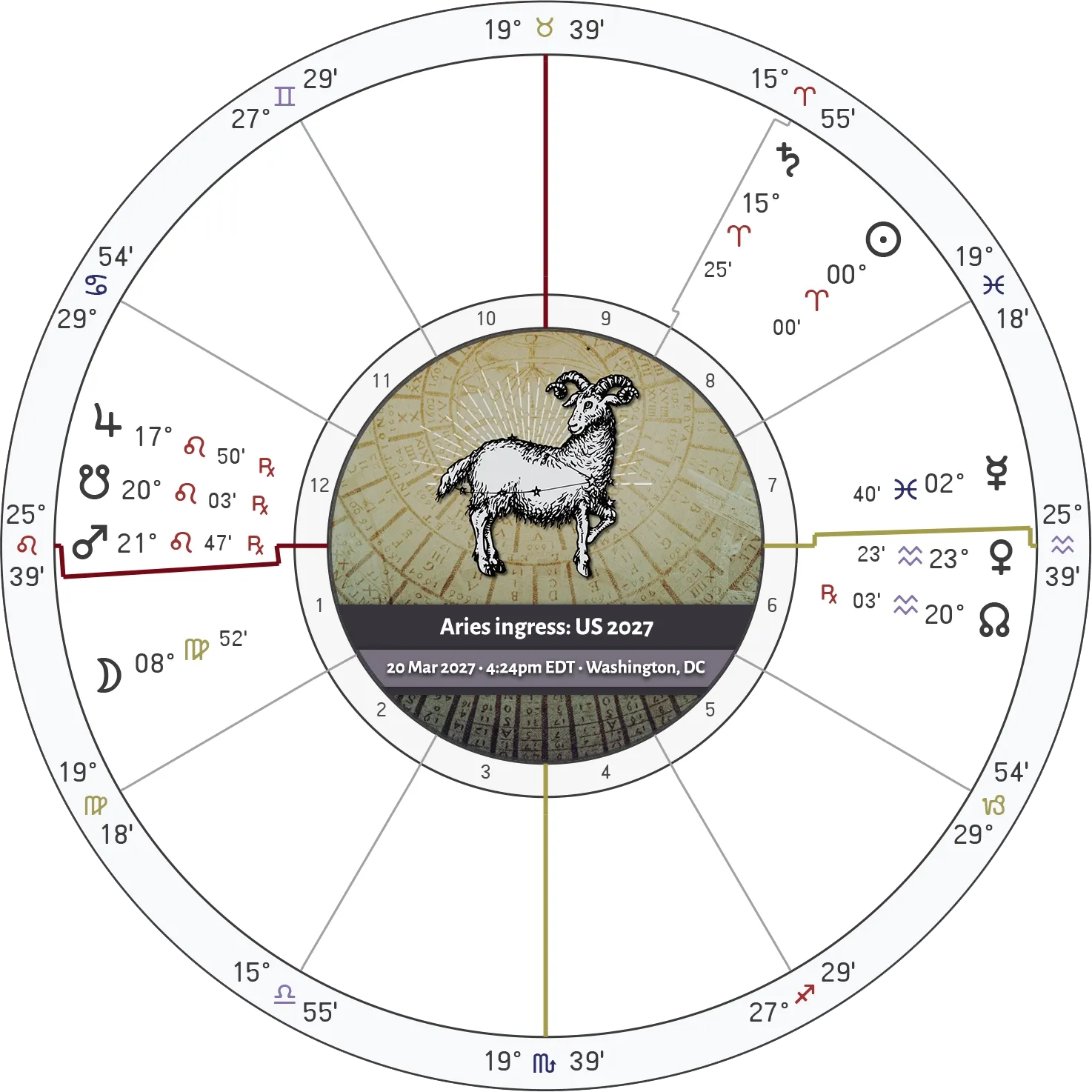
This suggests that the question raised here isn't confined to a single election date. It’s part of a longer arc in which the United States will be repeatedly confronted with choices about power, restraint, and the use of force within its own borders. Whether those choices are made with care or with coercion remains to be seen. What the astrology indicates, with unusual clarity, is that the coming period demands vigilance, individual and institutional courage, and a refusal to treat extraordinary measures as routine.
That is where this analysis leaves us, with a warning signal that merits sustained attention – and with the recognition that how this moment is handled will shape not only the 2026 midterms, but the political climate well into the astrological year that follows.