The triple conjunction of Saturn, Mars and Mercury

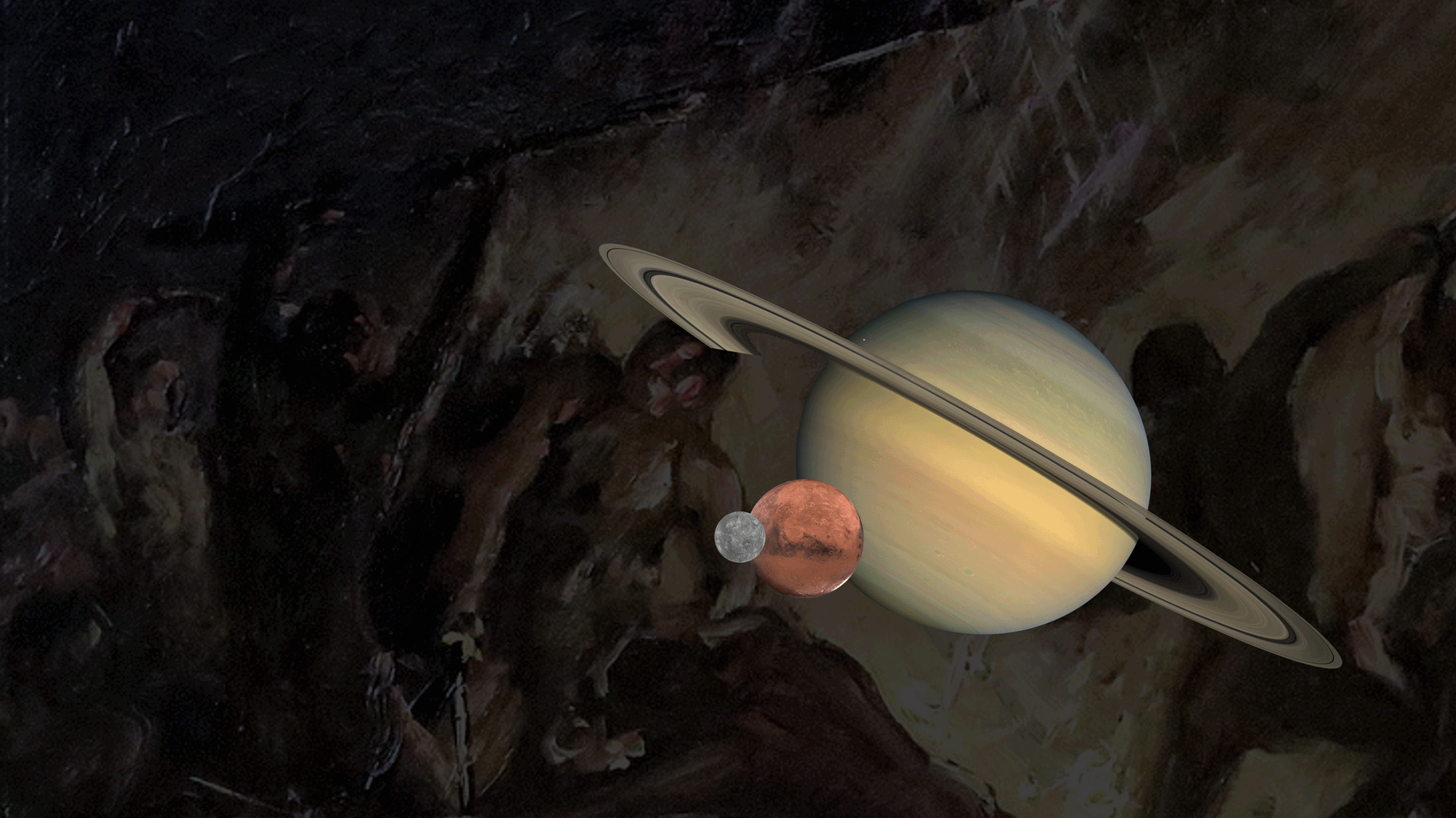
A Saturn–Mars conjunction is already a significant event in mundane astrology. These two malefics meet in the same degree roughly every two years, and their conjunctions have long been read as markers of conflict, severity, and forceful reorganization – themes that surface in the world in concrete ways as the conjunction forms and reaches climax at the following squares and opposition.
But the conjunction that perfected yesterday in 7° Aries brought Mercury into the same degree as both planets, giving us a rare triple conjunction of Saturn, Mars, and Mercury sharing a single point in the sky.
That is unique, and invites a different quality of attention.
Mercury in the middle
To read this configuration, it helps to know the sequence. Mars and Saturn conjoin first in 7° Aries, establishing a short corridor of sorts between the two as Mars begins to separate. Mercury then enters that corridor, conjoining Saturn first then moving forward toward Mars – transiting the space between the two malefics, one already behind it, one still ahead. This is the classical condition known as besiegement: separating from one hard planet to apply to another one. It was during that transit – Mercury besieged between the conjunctions – that yesterday's headline broke.
Mercury rules journalists, analysts, educators, merchants, scientists and inventors, software developers, and anyone whose livelihood depends on the movement of information and goods. It governs communication infrastructure, supply chains, transport networks, bureaucratic processes, the clever devices of financial markets. When Mercury is besieged by the two malefics, all of those things come under pressure – Mercury becomes caught between obstruction and aggression, between cold restriction and hot violence.
Yesterday, as Mercury transited between Saturn and Mars in 7°-8° Aries, a story broke in the American press: eleven scientists and researchers – specialists in national security, aerospace, nuclear physics, anti-gravity technology, pharmaceuticals – have died or gone missing over recent years under circumstances that have now prompted both a congressional investigation and an FBI inquiry. The cases involve figures from NASA's Jet Propulsion Laboratory, Los Alamos National Laboratory, MIT, the Air Force, and related institutions. Both the House Oversight Committee and FBI Director Kash Patel have confirmed the pattern is being treated as a national security matter.
 Joe Edwards and Anna Skinner
A second headline from the same window: Iran's Islamic Revolutionary Guard Corps released a video threatening the destruction of the $30 billion Stargate AI data center in Abu Dhabi – OpenAI's premier facility in the region – releasing satellite imagery of the site with the pointed message that nothing stays hidden from their sight. The threats came alongside Iranian rocket strikes that have already disrupted Amazon AWS data centers in the Gulf. Communication infrastructure, information networks, the physical architecture through which the world's data moves: Mercury's significations, caught between two armed adversaries, with the ceasefire due to expire Wednesday, April 22.
 Mark Tyson
So here we have it: Mercury besieged between two malefics. The educated, the technically capable, the bearers of knowledge and classified access, caught between forces that would restrict, extinguish, or consume them – and alongside them, the infrastructure of information itself, the data centers and communication networks that now underpin roughly 60% of US economic growth.
AI is currently the load-bearing column of American financial stability, propping up a market where most other sectors are flat or underperforming inflation. The physical destruction of data center infrastructure could send shockwaves through markets that have few other engines running.
Again: Mercury signifies clever, expedient devices through which markets are manipulated and gains are realized – the instruments, the arbitrage, the algorithmic sleight of hand through which capital moves and multiplies. A besieged Mercury, hemmed in by both malefics, suggests precisely those mechanisms under threat. The tricks that keep the system running are the tricks most at risk of failing.
What the humoral character tells us
Saturn and Mars share dryness, and Aries intensifies that quality further. Dryness severs, restricts, and closes off exchange. At the moment of the triple conjunction, Mercury is furthest south in latitude of the three. Visually, this places Mercury beneath Saturn and Mars – an inferior planet having to push through a problem much larger than itself. Mercury's significations appear here at their most exposed and vulnerable.
Applied to mercurial systems – the channels through which information and goods and people move – this points readily toward disruption and suppression: flows of information interrupted, channels narrowed or corrupted, networks strained by obstruction or deliberate interference. Disinformation is a natural expression of this combination, severing trust in the mechanisms through which truth ordinarily circulates.
Reception and allegiance
Saturn's in its sign of fall in Aries, receiving neither Mercury nor Mars with any welcome. The greater malefic presses down upon a territory it has no right to rule, stripped of the dignities that would give its presence constructive form. Aries is historically associated with Palestine, Lebanon, and Syria, and what we see unfolding in Gaza, Lebanon, and across the broader region offers some of the most immediate expressions of this symbolism in the world right now, though the conjunction's reach will extend into many other places and situations as its influence unfolds.
Unlike Saturn, Mars can receive Mercury. Reception here means that the counsel Mercury gives Mars is taken inward and acted upon. What counsel would a besieged, peregrine Mercury offer? Peregrine planets are like strangers with no local stakes and nothing to lose; they counsel risk freely. In Mars, Mercury finds a strong ally willing to act. In Mercury, Mars finds a clever and calculating advisor with every reason to side against a common adversary (Saturn). Together they favor ingenuity, sleight of hand, machinery, theft if necessary, violence if necessary.
If Saturn represents an afflicting, occupying presence in the lands described by Aries, it faces a dangerous alliance in the ruler of that sign and the resourceful, ascending planet moving in concert with it.
An ascending Mercury, and the Moon
Mercury is ascending toward higher latitudes throughout this period, moving upward out of its besiegement. Mars is moving upward alongside it, while Saturn descends toward its southern limits. In direction and in interest, Mars and Mercury are more easily aligned.
And the Moon is in Gemini, Mercury's sign. The Moon signifies the public – ordinary people, service workers, agricultural laborers, migrants, caregivers, those most exposed to shifts in food supply, housing, and public health. Gemini is hot and moist, and the Moon is the principal source of moisture in the sublunar world. Moisture here means connection, adaptability, the capacity to reach across and find new channels when the old ones are blocked.
Gemini's a hot sign, and the Moon's in its first quarter: while some moisture should temper the triple conjunction, the heat of it remains. The Moon's arrival draws the public into this story actively, stepping forward as participants, adapters, maybe even resistors. The moist, mutable quality of Gemini supports improvisation, parody, lateral thinking, and the invention of new channels when the established ones fail.
Reading three planets at once
Triple conjunctions reward a bit of disaggregation. Three planets sharing a degree can be having three entirely distinct experiences and contributing three entirely distinct dynamics to what unfolds – what can we learn about the specific condition, direction, and allegiance of each?
Several tools help pull the three apart. Latitude tells us about dominance: the planet riding highest transmits its influence with the most force.
Essential dignity tells us about native authority: whether a planet is on home ground or operating as a stranger.
Reception, when it exists, tells us about obligatory dynamics in play: whether one planet takes counsel from another, and in what direction that counsel runs.
And humoral character tells us what each planet actually contributes to the mixture – what qualities it stirs into the sublunar world and whether those qualities tend toward balance or extremity.
Run each planet through each of these lenses separately, and the three conjunct planets reveal themselves as three distinct actors with distinct conditions, distinct interests, and distinct resources – sharing a degree, but hardly sharing a fate.
Saturn is weakened, isolated, facing a hostile environment. Mars is strong, militant, allied with the resources of its own land. Mercury is hemmed in but ascending, counseling Mars, heading upward toward freer air.
Watching and waiting
The conjunction has perfected, and we'll see it begin to manifest before the first opening square on September 1.
The ascending Mercury–Mars alliance remains active well past the exact degrees. Both planets are climbing in latitude while Saturn descends, and that directional contrast – two planets rising against one falling – gives the story a trajectory. Renewable energy overcoming regulatory resistance is one expression of this. Organized resistance moving faster than the forces trying to contain it is another. The specific manifestation will depend on the chart in question and the territory being read. But the structural dynamic is clear enough: the resourceful ascending pair, and the isolated descending one.
Watch also where Mercury lands as it separates. A planet that has just survived besiegement and is heading for clearer air carries something of what it passed through – and what it does next will begin to show what counsel it gave Mars, and whether Mars acted on it.