The Slow Sinking of America’s Flagship

On Saturday, June 23, 1951, throngs of people stood in extreme daytime heat at the Newport News shipyard in Virginia to watch Lucile Connally, wife of Texas Senator Tom Connally, swing a bottle of champagne against the bow of the SS United States. [1] Reports say that more than twenty spectators collapsed in the heat before the ceremony was over.
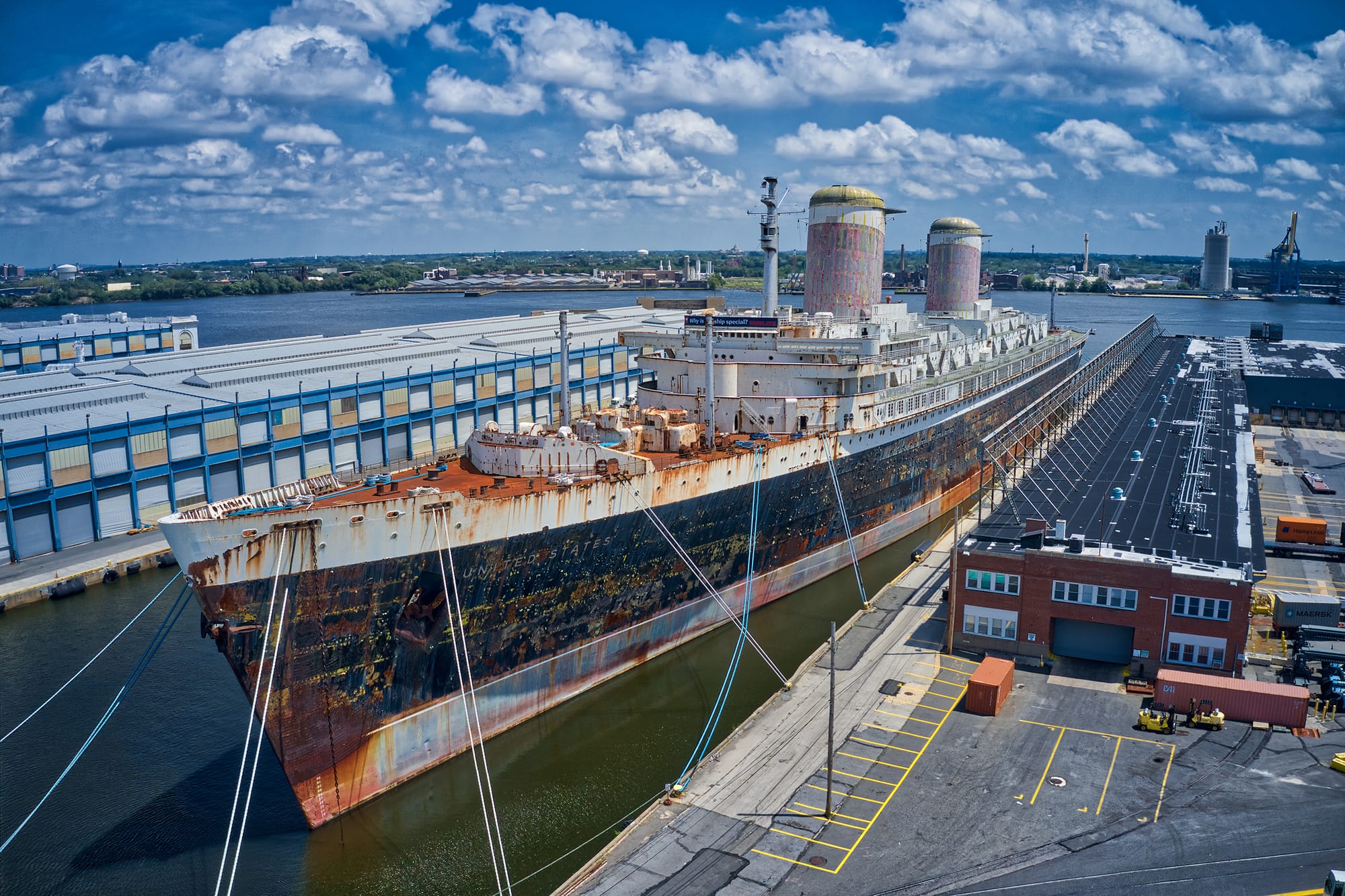
The ship had been built in a dry dock, the first ocean liner built that way, so her launch was a float-out: as the celebratory champagne bottle broke, tugs drew her out of the flooded dock and into the James River. She was about 70 percent finished at this point, but her funnels were already painted in the red, white and blue of United States Lines.
Aspirations for a naval giant
The speeches that day were about rivalry and war. Vice Admiral Edward Cochrane, the federal maritime administrator, told the crowd, “we are playing in the major league of the North Atlantic.” John M. Franklin, president of United States Lines, said her entry into service would be the first time since 1875 that the country could compete at sea with its foreign rivals.
Naval architect William Francis Gibbs designed her to warship standards, with heavy compartmentation and separate engine rooms. She could carry 12–14 thousand troops 10,000 miles without stopping for fuel or water. The New York Times reporter at the launch wrote that she “could never have been built as a commercial vessel.”
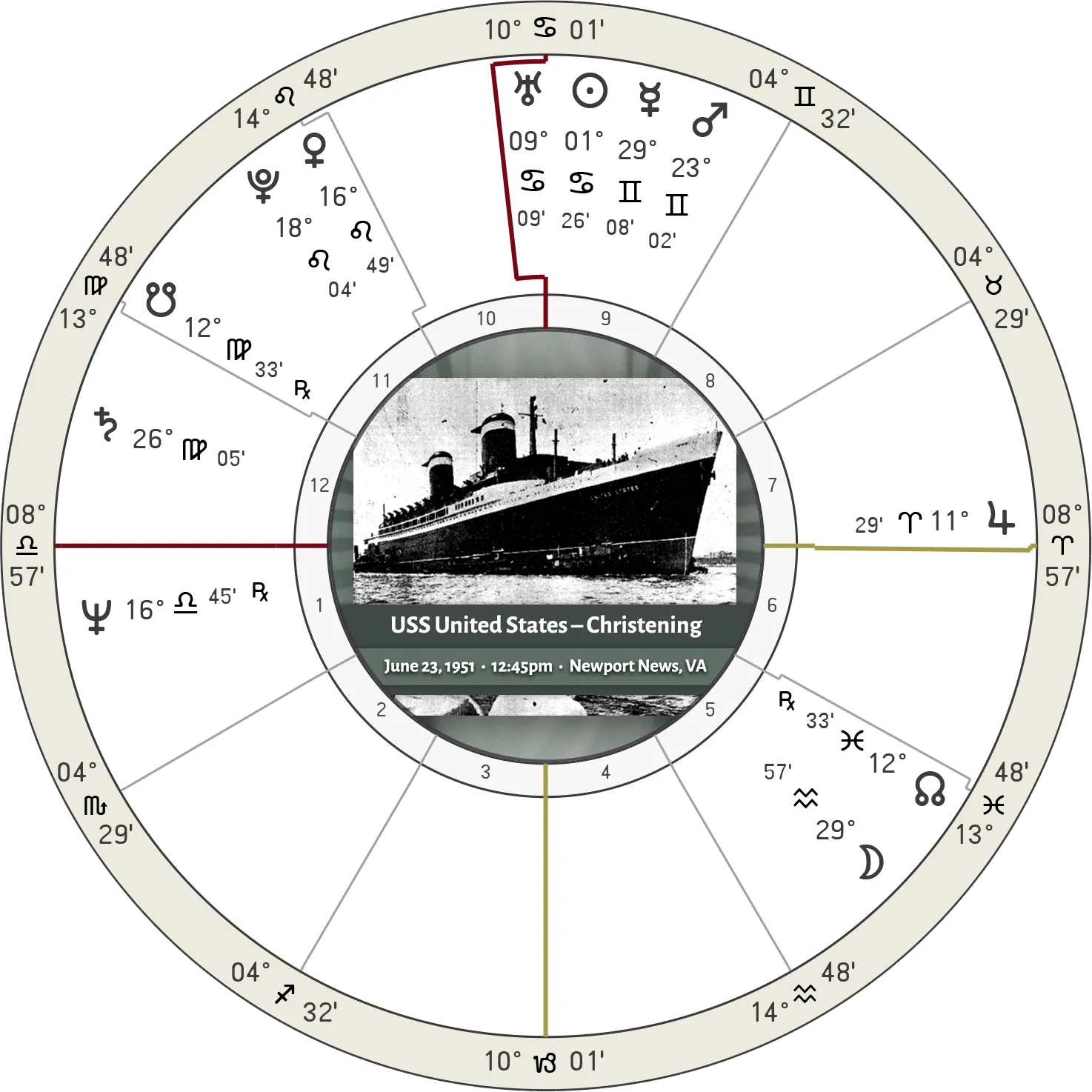
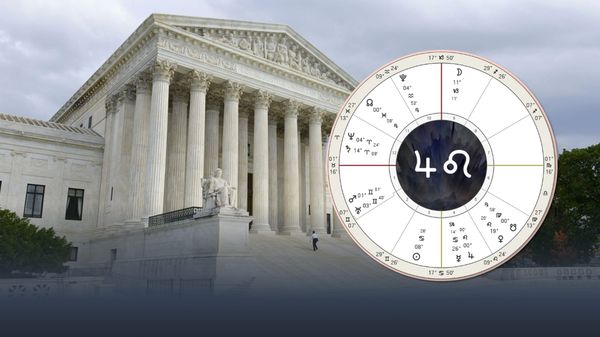
At the christening the Moon was applying to a trine of the Sun, which brings the two lights into good relation. The Moon is a collective planet, and a favorable tie between the Moon and the Sun puts the public behind whatever is being honored at that moment. The launch drew 12,000 spectators despite 100-degree heat and put the ship on the front page of the next morning’s New York Times.
The Sun was also applying to a conjunction with the United States Jupiter (5° Cancer). Jupiter signifies wealth and increase, so the Sun’s approach to the nation’s Jupiter describes something the country spends heavily on and holds up as its own. The contract for Hull 488 came to $70.4 million, with the government covering the defense features.
Jupiter was descending over the 7th house cusp, the house of open enemies and of war, perhaps reflecting the aspirations of this ship as a means of fighting. Her backers spoke of her in those terms: every speaker at the launch stressed her value as a naval auxiliary, and the Times reporter called that value “incalculable.”
Mars, meanwhile, was transiting its position at the nation’s founding, so the US was undergoing a Mars return as the ship was named. Mars governs soldiers and weapons, and its return marks a renewal of the country’s means to fight. Gibbs built the ship to that purpose, ready to ship up to 14,000 troops, which the Navy kept secret for 26 years.
Withdrawal from service & repurposing
United States Lines announced the ship's withdrawal on November 11, 1969, after seventeen years in service, as airlines took her passengers and strikes and subsidy cuts raised her costs. For the next 55 years she passed through a string of owners, none of whom could find a path to finance her return to service.
From 1996 she sat at Pier 82 in South Philadelphia, until a rent dispute with the pier’s owner ended in a 2024 court order to move her. [2] Okaloosa County, Florida, bought her that fall to sink as an artificial reef. [3] She was towed to Mobile, Alabama, where crews spent more than a year stripping out fuel and hazardous material. Her funnels and radar mast were cut away and saved for a land-based museum. [4]
Preparing the SS United States
The county set the sinking for Thursday, November 12, 2026. A forecast of high winds moved it up a day, to Wednesday, November 11 – Veterans Day, and 57 years to the day after her retirement was announced. [5] Federal rules forbade the use of explosives, so she was sunk by flooding.
Workers had cut 10-by-10-foot holes through her decks and removed more than 400 portholes. They also pulled out the tanks on her boiler-cooling seawater lines, so that opening the valves would let the Gulf in. Delays pushed the start into the afternoon, with deployment commencing at 1:40 p.m. CT.
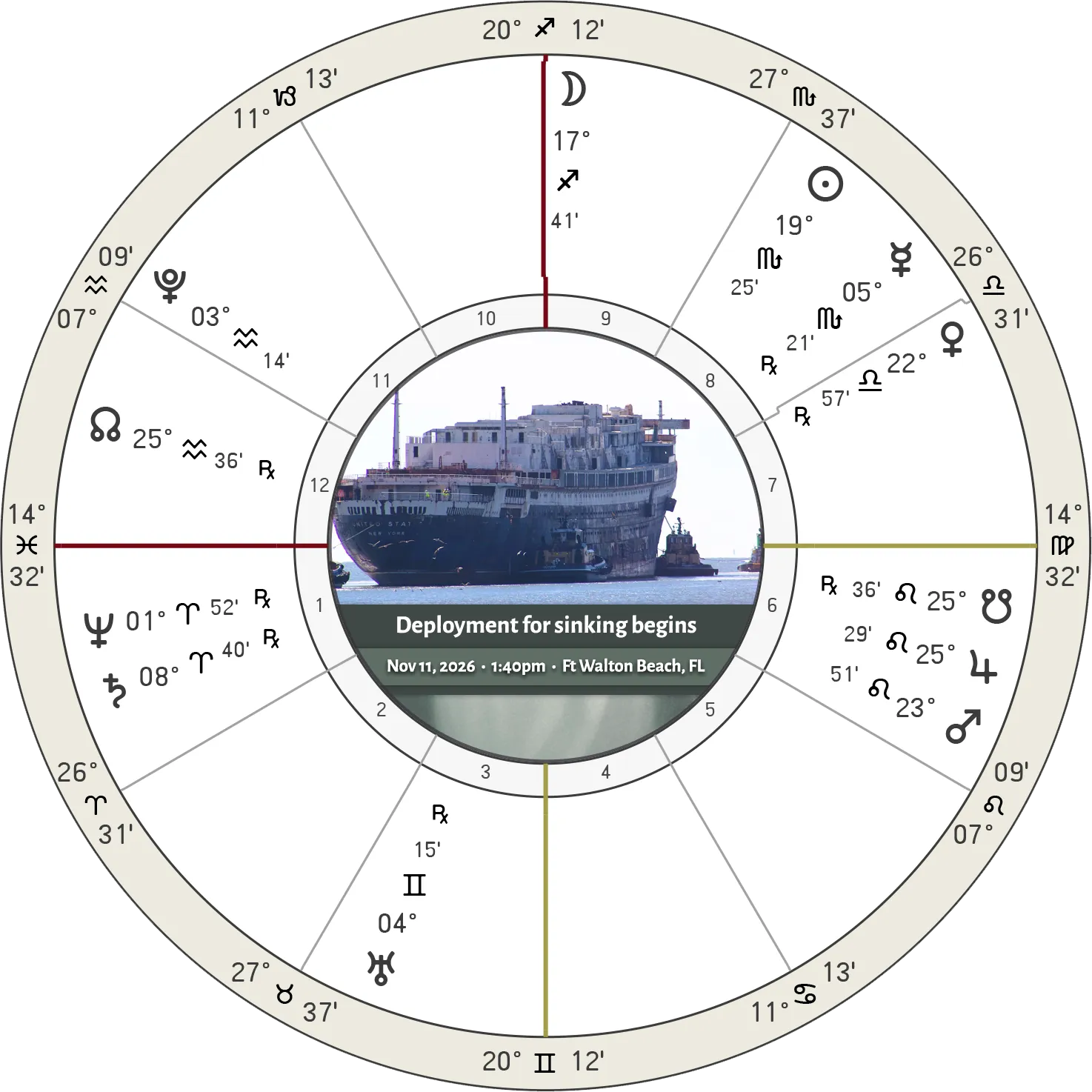
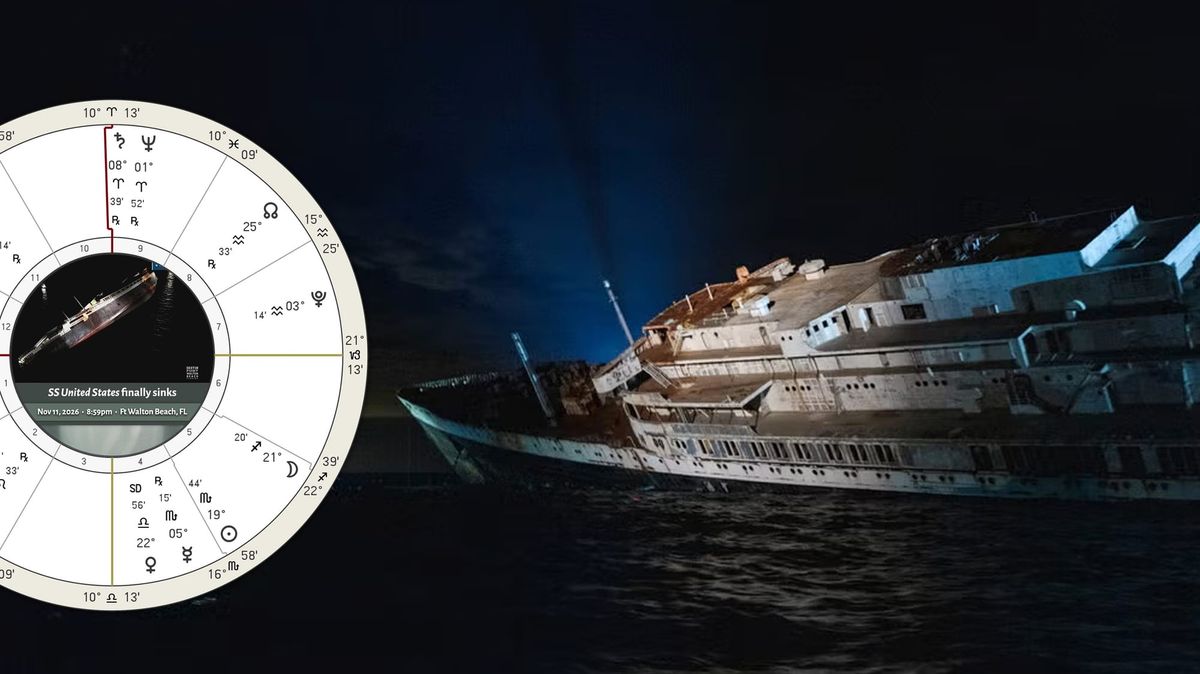
The Moon signifies ships, and as the sinking began the Moon was angular in Sagittarius. Sagittarius's associations with war are often overlooked, but it is a fire sign, and its image is a mounted archer armed for ranged combat. That suits a liner built to carry a division across an ocean, and the Moon’s angular place keeps the ship’s original purpose in view on the day she went down.
The angular Moon was applying to Mars and to Jupiter, both cadent in the 6th house. Cadent planets describe things that fall and lose value, so the Moon’s application to two of them points the ship’s motion downward. Jupiter rules the ascendant and was conjunct the South Node, which adds a second testimony of falling and sinking. Saturn was in the ascendant, too – Saturn is associated with drowning, and retrograde in the ascendant it can describe a slow descent that ends in burial, which is a fair account of a hull settling onto the floor of the Gulf.
So many retrograde planets would have an impact on the speed of descent. Saturn retrograde in the 1st house, with Venus on the 8th house cusp and Mercury in the 8th both retrograde – retrograde planets positioned like this describe slow and halting progress. The Moon’s application to Mars and Jupiter in fixed signs points the same way, since fixed signs take their time.
The ship's final sinking
Crews spent the next two hours filling the hull before officials opened the first two valves at 3:50 p.m. about 22 nautical miles southwest of Destin, with charter boats crowding the edge of a one-mile safety zone. All valves were open by about 4:50.
The county had estimated she would go down in 45 minutes to three hours. She stayed afloat for another four hours, and a county spokesman said her unsinkable design “has definitely given our crews some challenges today.” Around 9 p.m. she leaned to one side and went under within a few minutes. A dive survey will establish how she lies on the bottom, about 180 feet down and 12 nautical miles from the wreck of the aircraft carrier Oriskany.
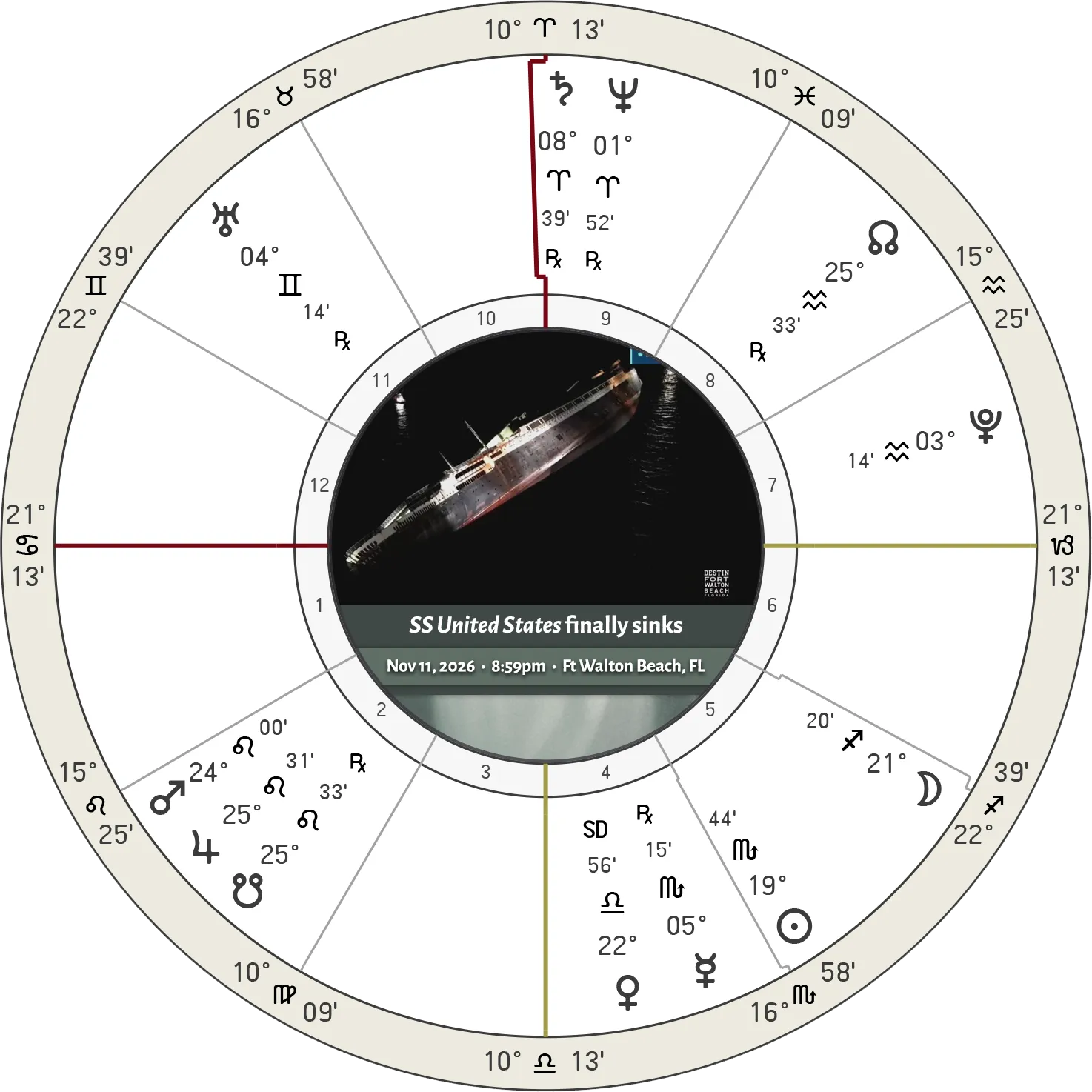
When the ship finally went under, Saturn had moved from the ascendant up to the midheaven. Saturn stood at 8° Aries, retrograde, and 8° Aries is the degree that was setting at the christening in 1951. The western angle is where planets set and leave view, so the place that marked endings at her launch received Saturn at the hour of her burial. Saturn also rules the 7th and 8th houses, both associated with endings and death, so the houses of endings belonged to the planet at the top of the sky.
The Moon, which signifies the ship, had come to the 6th house cusp. A Moon on a cadent cusp describes something falling out of view, and the Moon was still applying by trine to Mars and Jupiter. Mars and Jupiter were conjunct each other and the South Node, a triple conjunction in the 2nd house. In mundane astrology the 2nd house is associated with armies and navies, so the Moon’s last application ran to the house of the military, the purpose she was built for in 1951.
Before the sinking I posted the times I expected for the final descent:
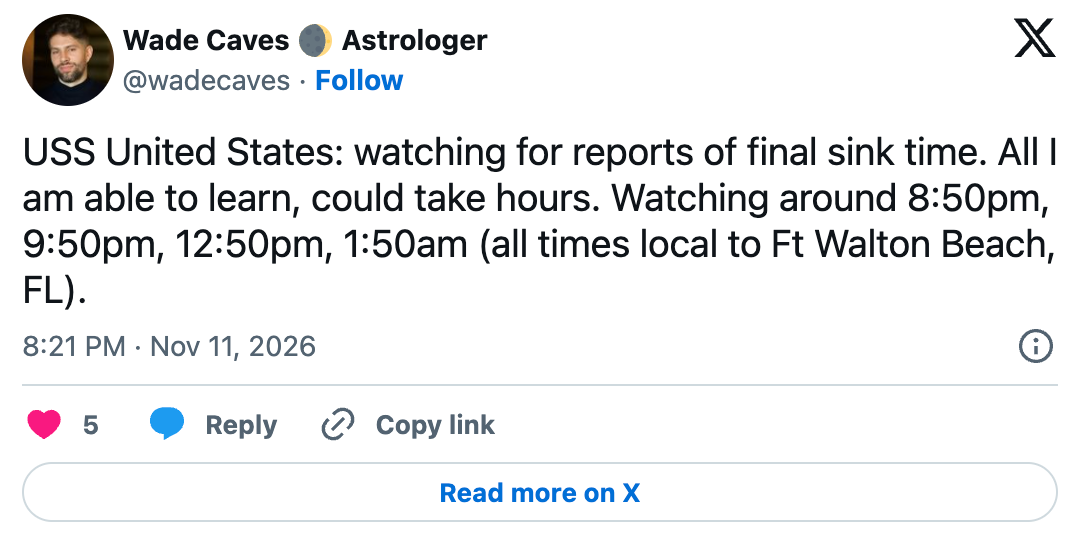
The first was around 8:50 p.m., when Saturn would reach the midheaven – and Saturn did chiefly signify the destruction of the ship by being in the 1st house of its deployment and transiting the setting angle at its christening. This seemed such a strong time that I nearly announced it alone (at 7:21 p.m. CT), but local advisors noted that progress had been slow, some even suggesting it could run into the early hours of the morning. So, I thought to name a few more options.
If she held on past 9 p.m. local time, the next three times I wagered were 9:50 p.m., 12:50 a.m. and 1:50 a.m., when Venus, the Sun and the Moon would each cross the 4th house cusp. Venus, because it was the Moon's next aspect at deployment, and Venus was retrograde on the 8th house cusp. The Sun, because of its prominence in establishing a Sun–Jupiter theme at the time of christening, and a square was building between them at the time of deployment. The Moon, because of its natural significations, and because it was so prominent at the time of deployment.
She went under around 9 p.m. (reports say 'just as the clock struck nine'), within 10 minutes of the first of those timings.